


The opening contradiction
These numbers shouldn’t add up in 2026. But they do.
91% of Australian marketing businesses say they use AI (BizCover, 2025). Three in four Australian business leaders say they wouldn’t hire someone without AI skills (Microsoft / LinkedIn Work Trend Index, 2024). Yet just 3.5 per cent of Australian marketing job ads ask for it (My2Cents Job Ads Analysis, Apr-2026)
Pick any two of those numbers, and the gap between them is enormous. Put all three together, and the contradiction is the whole story.
We went and looked at what Australian marketers — or the employers hiring them — are actually asking for in the job market. We analysed approximately 13,000 publicly available Australian marketing job ads from leading Australian job boards and filtered for ads that explicitly mention AI by name.
The answer: 3.5 per cent.
This isn’t a one-survey fluke. ADMA’s State of AI in Marketing 2026 (n=1,092) puts weekly AI use at 77 per cent and daily use at 52 per cent. Microsoft’s 2024 Work Trend Index puts AI use at work at 84 per cent across Australian knowledge workers. Everywhere you look, the “say” side is high. The “do” side — what employers write down — hasn’t moved.
And the part that made us stop and redo the numbers: the universities responsible for training the next generation of marketers are doing all three at once — using AI, hiring for it, yet rarely asking for it on paper. What’s more, they’re some of the more sophisticated users of AI, applying it to student recruitment and retention. More on that below.
What “performative AI” actually looks like
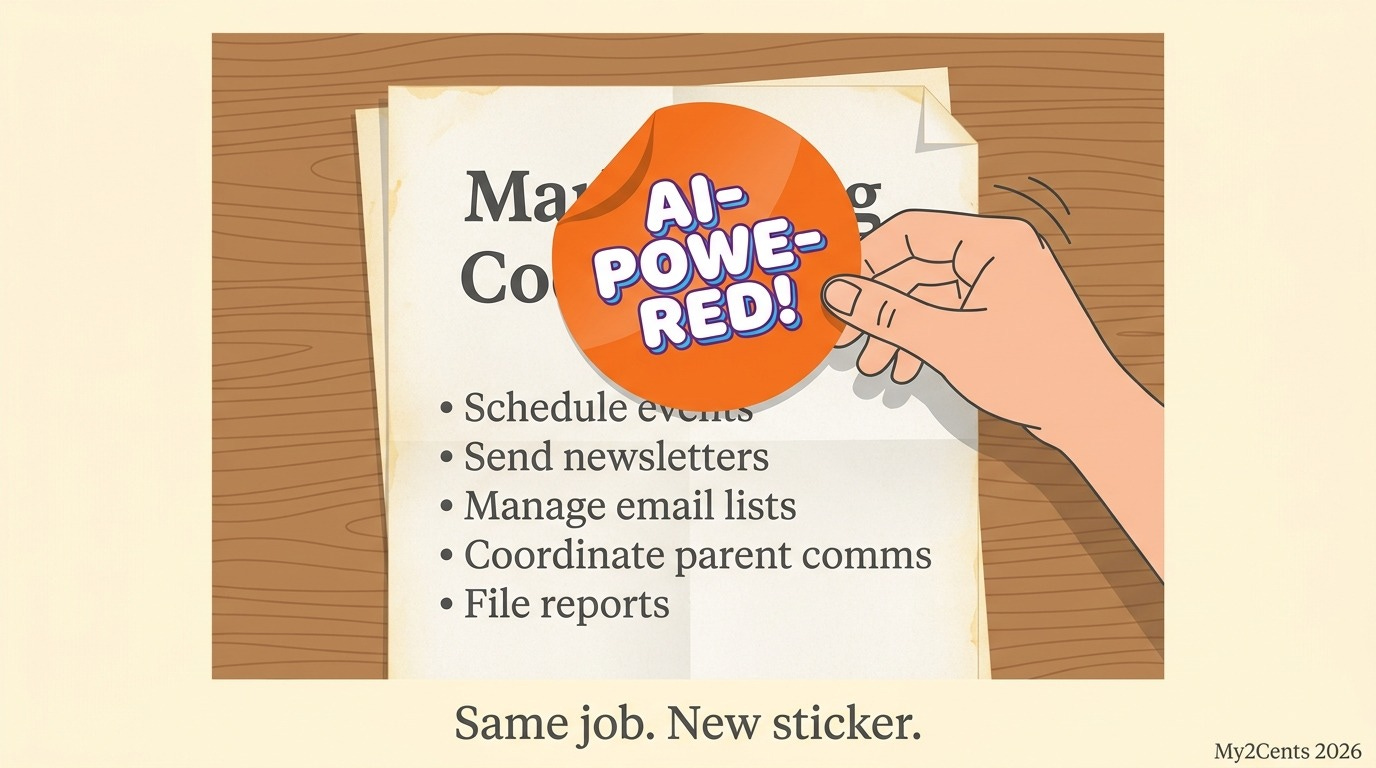
We built a four-level capability assessment to read these ads at scale (we’ll come back to the methodology). The bottom level we call Performative AI — roles where the employer markets itself as AI-driven, but the actual job description doesn’t need, require, or use AI.
We’re not naming and shaming. But we can describe the patterns cleanly, because they repeat.
The boilerplate twins. A major Australian education employer runs the line “access to targeted AI tools and training with a focus on innovation and strong ethical standards” in two unrelated school marketing roles. The actual duties — events, parent comms, and list-building — contain no AI work. When the same sentence appears verbatim in two job ads at the same organisation, it’s HR copy-paste.
The “AI-powered company, traditional role” move. A major creative asset platform uses the line “as AI transforms the creative landscape, we’re committed to building what’s next” in both a senior brand and social role and a senior CRM role. Neither JD asks for any AI capability. An Australian B2B data science business opens its content marketing JD, declaring itself “a world leader in data science and artificial intelligence” — then asks for thought leadership content production with zero AI tool mentions.
The job-board AI. In three content marketing roles in our dataset, the only AI mention in the entire ad is the recruiting platform’s own applicant-tracking algorithm. Your job is now AI-enabled because the job board’s back-end sorts résumés.
The “AI as elevator pitch” pattern. An AI-first B2B SaaS describes itself as building the world’s first AI-powered decision operating system. The role is junior marketing executive — content scheduling and event support.
In aggregate, this has two real consequences. Candidates searching “AI marketing roles” surface listings that have nothing to do with AI. And industry-level adoption statistics these ads feed into get inflated by language, not capability. The ad performs AI readiness. The job doesn’t require it.
Meet AI mentionitis
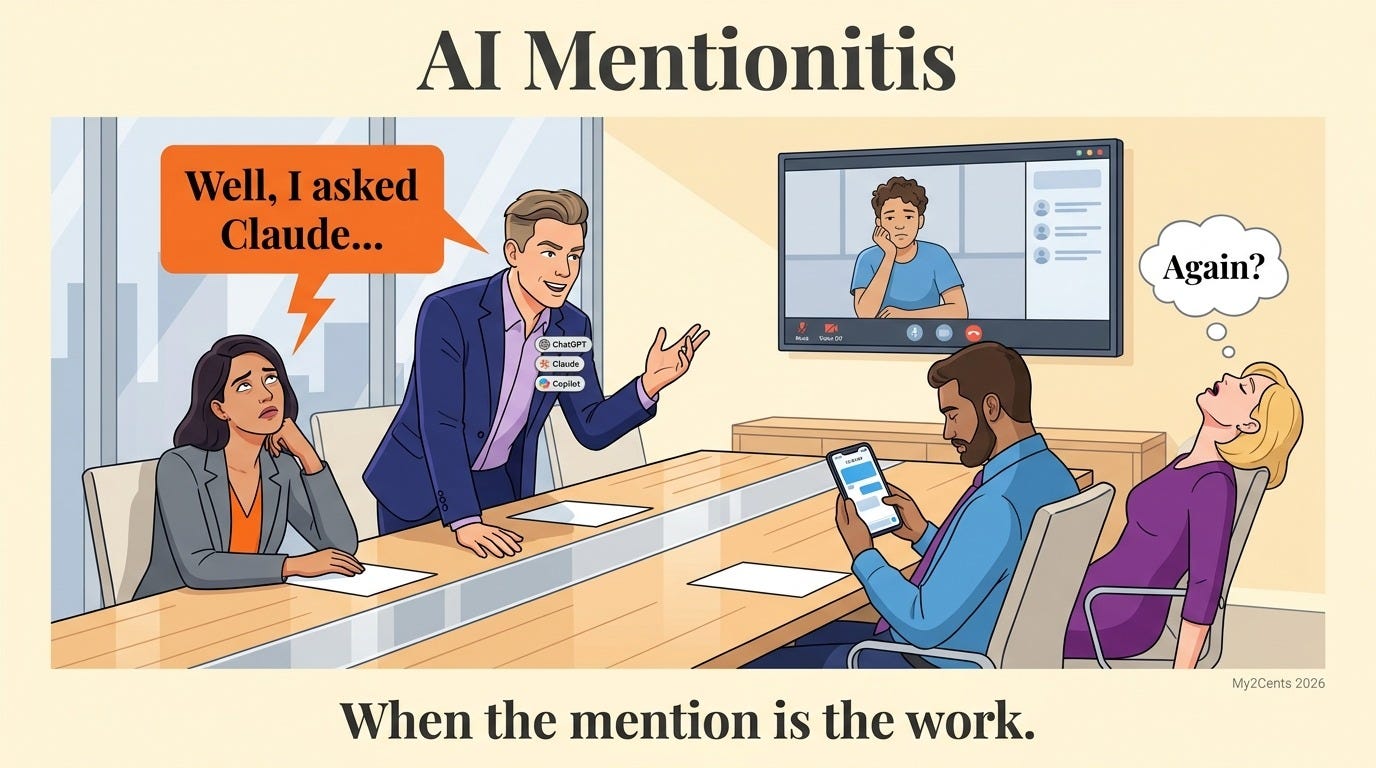
If performative AI is what ends up on the page, there’s a sibling condition that ends up in the meeting. We’re calling it AI mentionitis.
AI mentionitis is the manager who now prefaces every suggestion with “well, I asked Claude…”, or “Ben from accounts said ChatGPT said we should do this instead.” It’s the boss who used to drop client names, then consultancy names, and now drops AI tool names — as if the mention itself is the work. You know it when you see it. The comments section on any LinkedIn post about bad AI management reads like a support group.
It matters for the same reason performative AI matters: the claim to AI sophistication runs well ahead of the capability to back it up. Performative AI inflates the job market. Mentionitis inflates the company. Both are versions of the same thing — the say side of the gap running ahead of the do side. (A recent Substack post on exactly this phenomenon crystallised the pattern for us — worth a read.)
It’s also, for better or worse, the beat of corporate life in 2026. We’ll keep collecting examples. Send yours in.
The funnel — a way to read the market
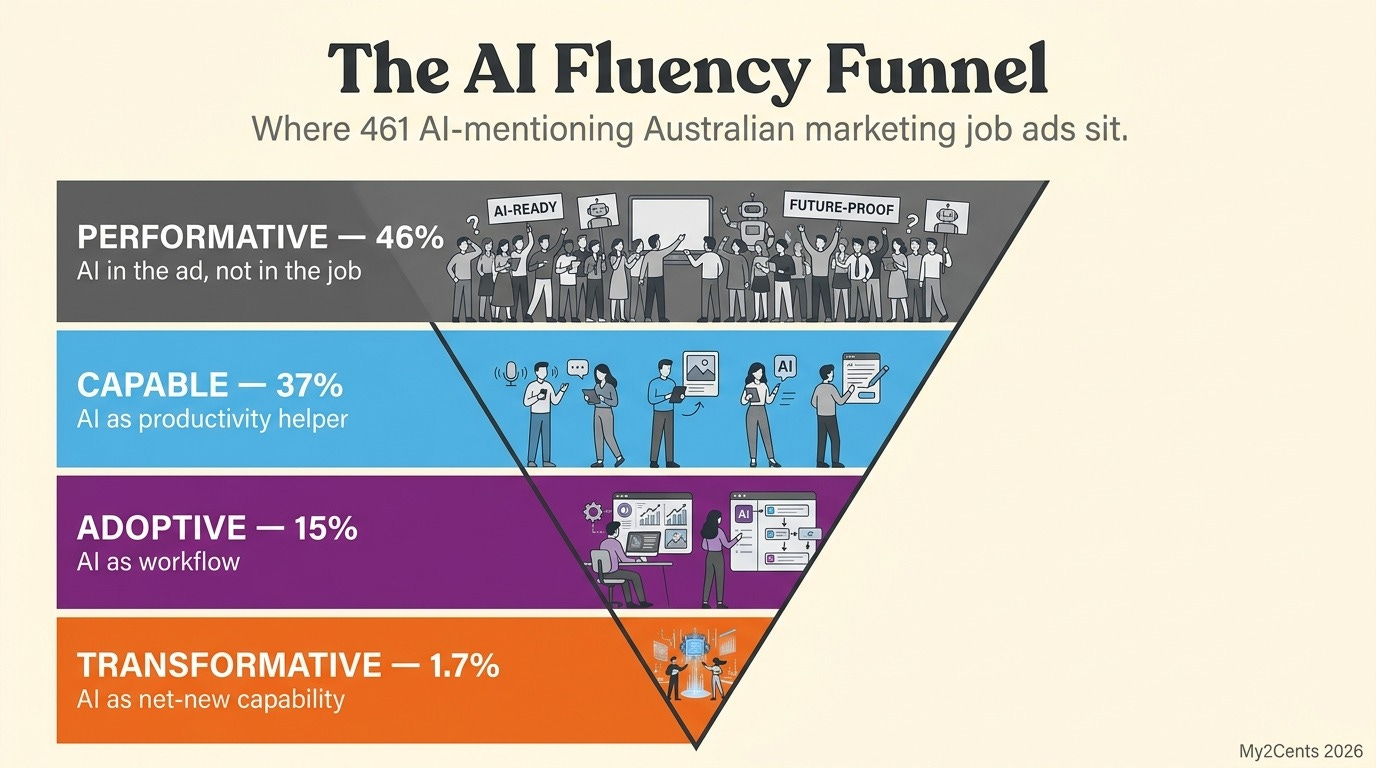
We scored each AI-mentioning ad against a four-level capability assessment (we adapted Zapier’s AI Fluency Rubric to align more closely with the marketing function). Think of AI capability as a funnel: the top level is thick with language, the bottom is thin with actual capability. Most Australian marketing ads sit at the top two levels — and the numbers drop away quickly as real AI work enters the picture.
Performative (Level 1). The ad mentions AI; the role doesn’t need it. The largest slice of AI-mentioning ads we’ve scored so far.
Capable (Level 2). The role would benefit from AI fluency and lists one or two concrete tools or tasks. AI is a productivity helper, not a rethink.
Adoptive (Level 3). The role explicitly redesigns workflows around AI. The marketer is expected to build prompt libraries, integrate tools across the stack, and lift team throughput.
Transformative (Level 4). The role changes what’s possible — AI agents in the marketing function, retrieval systems wired into customer data, or new capabilities that didn’t exist two years ago. Extremely rare in Australian marketing right now.
An upcoming post will dig into what that Transformative tier actually looks like up close — the Australian companies hiring AI-fluent marketers properly. For now, just know the top of the funnel is performative.
Why do job ads lag? (The reasons don’t quite wash either.)
We don’t have definitive data on why the gap exists. But here are the likely explanations a hiring manager would offer — and a counter-question for each.
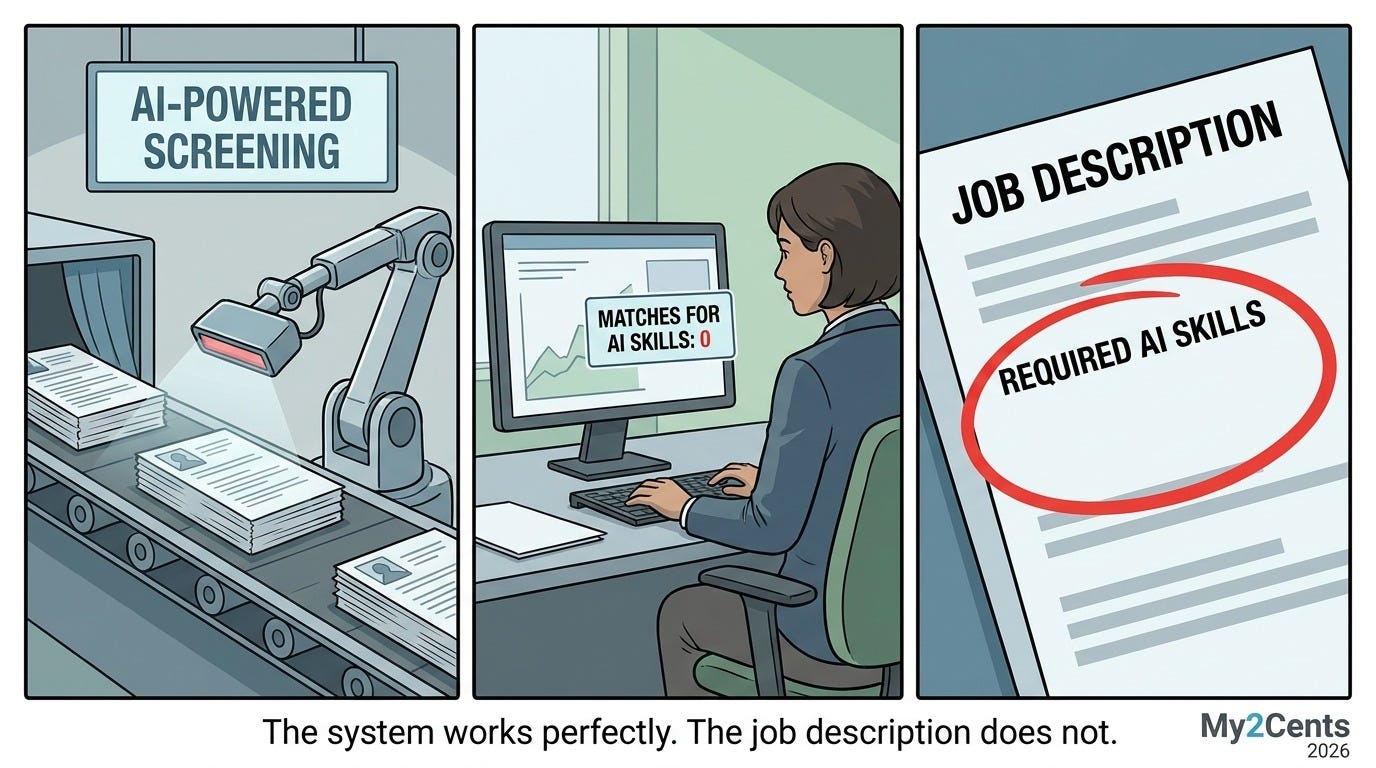
“We don’t need to put AI in the ad — it’s ubiquitous now.” Then how do you actually screen for it? If it’s not in the ad, candidates are less likely to include it — especially when they know their application is being screened by AI against the job description. The irony is that AI becomes invisible in the process designed to find it.
“We’ll just hire someone who picks it up on the job.” Like your existing team picked it up — quietly, without being asked, usually without being paid for the upskill. Are you running that play again for eighteen more months?
“We don’t have a company-wide position, so we won’t go out on a limb in the JD.” Fair. Which means the ad gets hedged, the marketer you hire hedges, and the gap persists another hiring cycle.
“It’s an old JD we haven’t updated.” Probably the most honest answer. The ATS was configured for 2022, the hiring manager is two rungs above day-to-day AI use, and the legal review flagged anything specific as a discrimination risk. Nobody’s wrong. Nothing moves.
“I use it daily. I’d never admit it at work.” A CMO at a large Australian employer told us this on a recent call. That’s the dynamic that creates shadow AI — and it’s in the same room as the data that says 91 per cent of marketing businesses use AI. Same gap, shorter distance.
None of these reasons are obviously wrong. Each one has a counterpoint that’s also not obviously wrong. The part worth noticing is that the reasons themselves carry the same say/do gap as the hiring data — and they probably always will, until the first hiring manager in each company decides to break the cycle and write the role at the Capable level.
The upside for marketers: if you use AI well, this is arbitrage. The demand is there — BizCover’s 91 per cent, Microsoft’s 75 per cent won’t-hire-without signal, ADMA’s 77 per cent weekly — it just hasn’t hit the job ads yet. Put AI on your CV in specifics, not adjectives.
Shadow AI is the symptom, not the disease
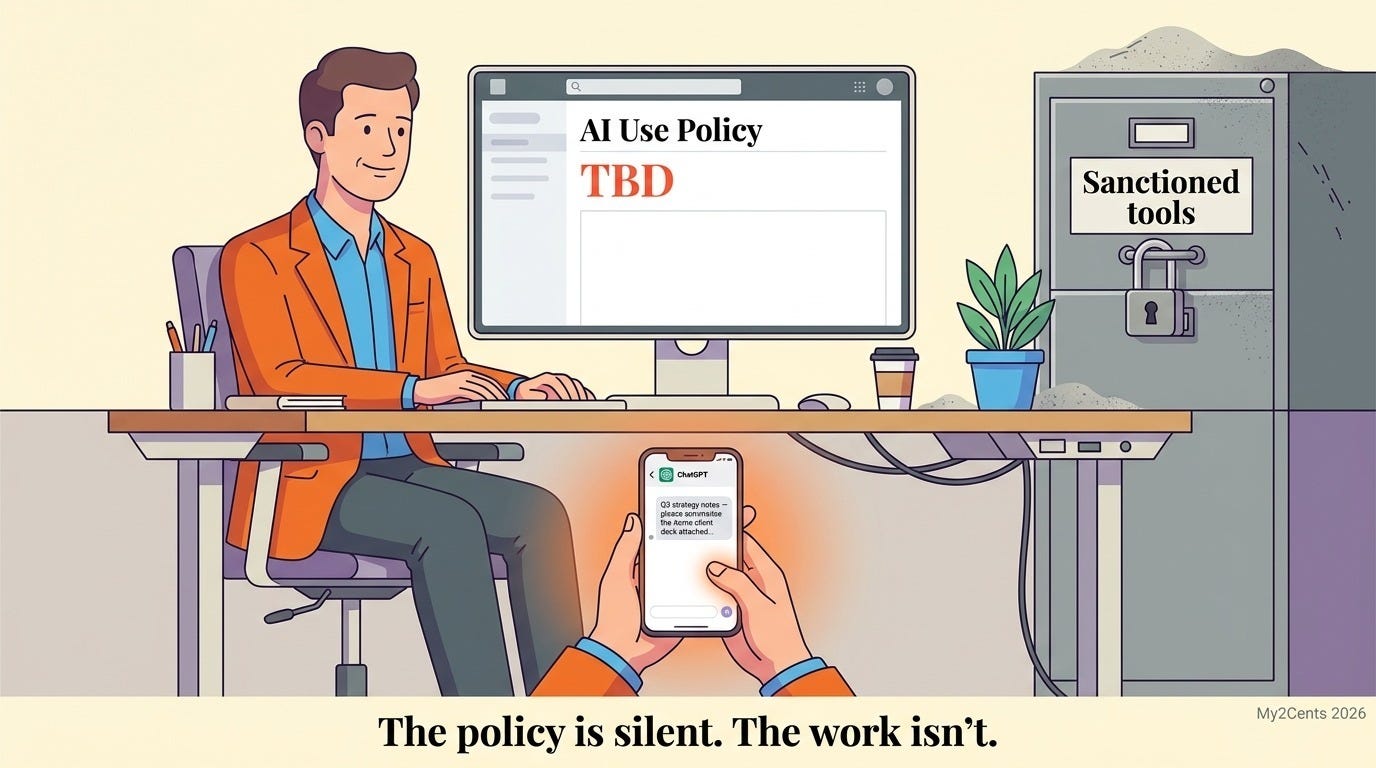
If 91 per cent of Australian marketing businesses use AI but only 3.5 per cent of marketing job ads ask for it, that gap has to land somewhere. It lands in shadow AI — employees using tools their employer hasn’t sanctioned, often on personal accounts, sometimes with client data in the prompt window.
Around one in four Australian employees are using AI tools without telling their managers (AHRI / HRM Magazine, December 2025). One in three Australian professionals regularly upload sensitive data to AI without oversight (Josys / Censuswide, September 2025). Only 30 per cent of Australian organisations have a workplace AI policy at all; 48 per cent of Australian employees admit using AI in ways that contravene company policies (KPMG / University of Melbourne, Trust in AI, September 2025). The State of AI in Australian HR report (QUT / AHRI, December 2024) found 27 per cent of Australian organisations have responded by banning generative AI outright — and the evidence says bans push shadow AI further underground, not out.
The instinctive read is that Australian professionals are risk-loving. They’re not. They’re operating in a policy vacuum. Only 13 per cent of marketers have had formal AI training (ADMA). IBM’s 2025 Cost of a Data Breach Report clocked an additional cost of about A$1 million on average when shadow AI is involved in a breach. That’s not a risk marketers are choosing to take — it’s one their employers have effectively outsourced to them by declining to write the policy.
The university paradox
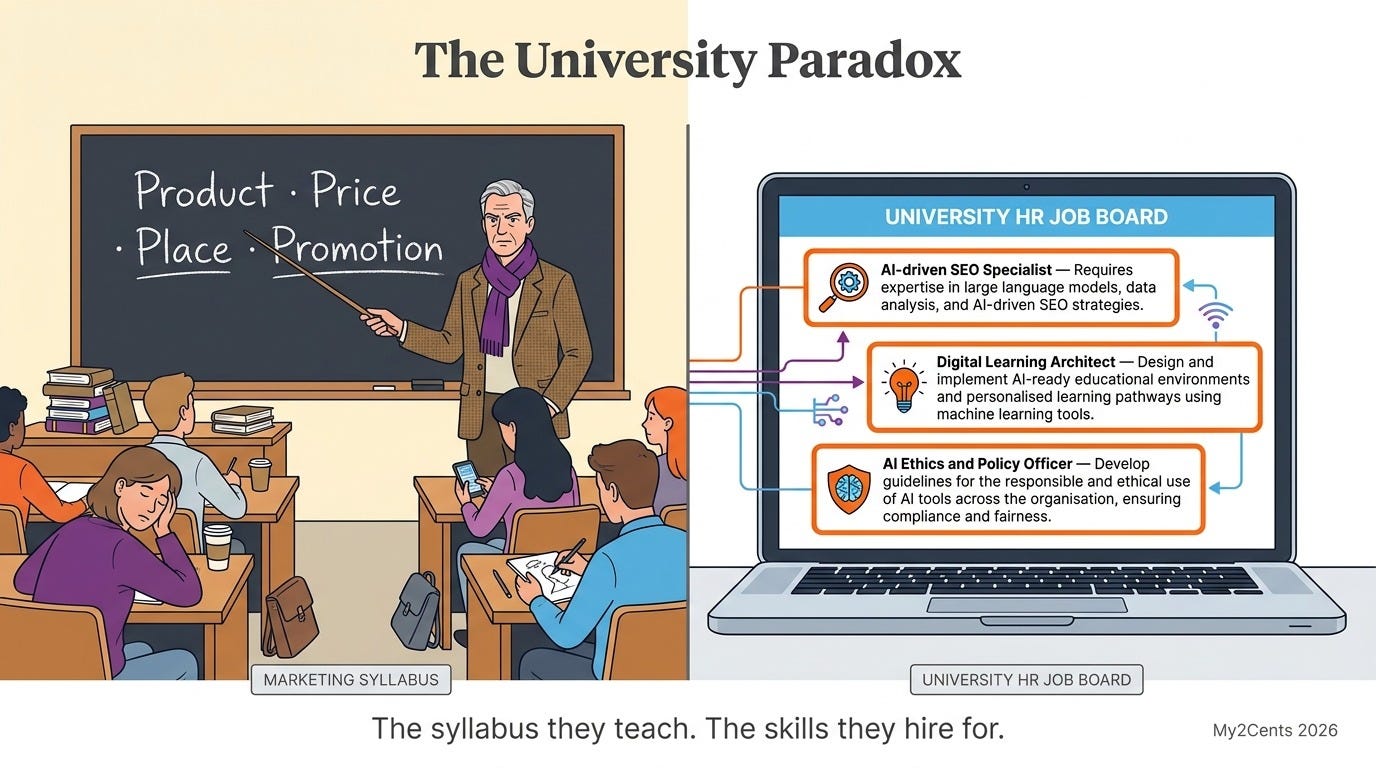
This is where it gets serious.
In March 2026, we analysed publicly available course information across 32 Australian universities — 629 marketing subject outlines in total. Eighty-four point three per cent had zero AI content in the syllabus. The two standouts were Bond University at 79 per cent of marketing subjects mentioning AI, and the University of Queensland at 61 per cent. Nobody else was close.
At the same time, Australian universities were advertising for AI-fluent applicants. A sessional academic role at an Australian university asked for applicants who can “operate in an AI-ready educational environment” and bring “familiarity with the appropriate and ethical use of AI tools, as well as the ability to guide students in developing responsible AI practices” — with no clarity, anywhere, on what “AI-ready” or “ethical” actually means in the institution’s own syllabus. Another Australian university recruited a digital PR producer, asking for “AI-driven” SEO and content skills. A third advertised a lecturer in data science and AI, while its own marketing faculty’s coursework contained zero AI references.
If AI is as ubiquitous as the industry says it is, you’d expect to see it clearly in how universities present their marketing capability. In practice, it’s hard to find. If a university were to say “this doesn’t reflect our current position” — that’s fine. The question then becomes: why isn’t it visible? If it’s a priority, it should be easy to find.
We’ve chosen not to name the institutions behind these examples — it’s a system problem, not a vice-chancellor problem. But if you’re a marketing graduate in 2026, this is the world you’re walking into: the employer market is asking for AI fluency you almost certainly weren’t taught, and the institution that just awarded you the degree — and very likely used AI to help recruit you — is asking for AI skills from its own staff that it didn’t put in your syllabus.
Meanwhile, in April 2026, the Australian and NSW Governments committed $11 million to turn TAFE NSW Meadowbank — already a Microsoft-partnered training site — into a national Digital TAFE Centre of Excellence: 50,000 Australians a year, microcredentials co-designed with Microsoft, AWS and Cisco, AI threaded through the curriculum (DEWR, Digital TAFE Centre of Excellence for New South Wales, 14 April 2026). The vocational sector is moving. Marketing schools are not.
We’ll dig into the university story properly in an upcoming post.
What good actually looks like
Bond and UQ are the named exemplars, and it’s worth being specific about why. Bond’s 79 per cent isn’t one headline “AI in Marketing” unit — it’s AI threaded through the curriculum, showing up in consumer behaviour, analytics, digital marketing and strategy subjects. UQ’s 61 per cent looks similar. Integrated, not bolted on.
RMIT added two new AI-focused units — AI in Marketing and Enterprise AI and Business Analytics — to its Bachelor of Commerce in March 2026. Progress, and heading in the right direction.
ADMA and AHRI have been publicly ahead of the industries they represent. ADMA’s State of AI in Marketing is the cleanest benchmark in the market. AHRI has been visible and direct about shadow AI and has called on HR leaders to stop treating it as a discipline problem and start treating it as a policy one.
They’re organisations that treated AI as a curriculum choice or a governance choice and wrote it down.
What this means for you
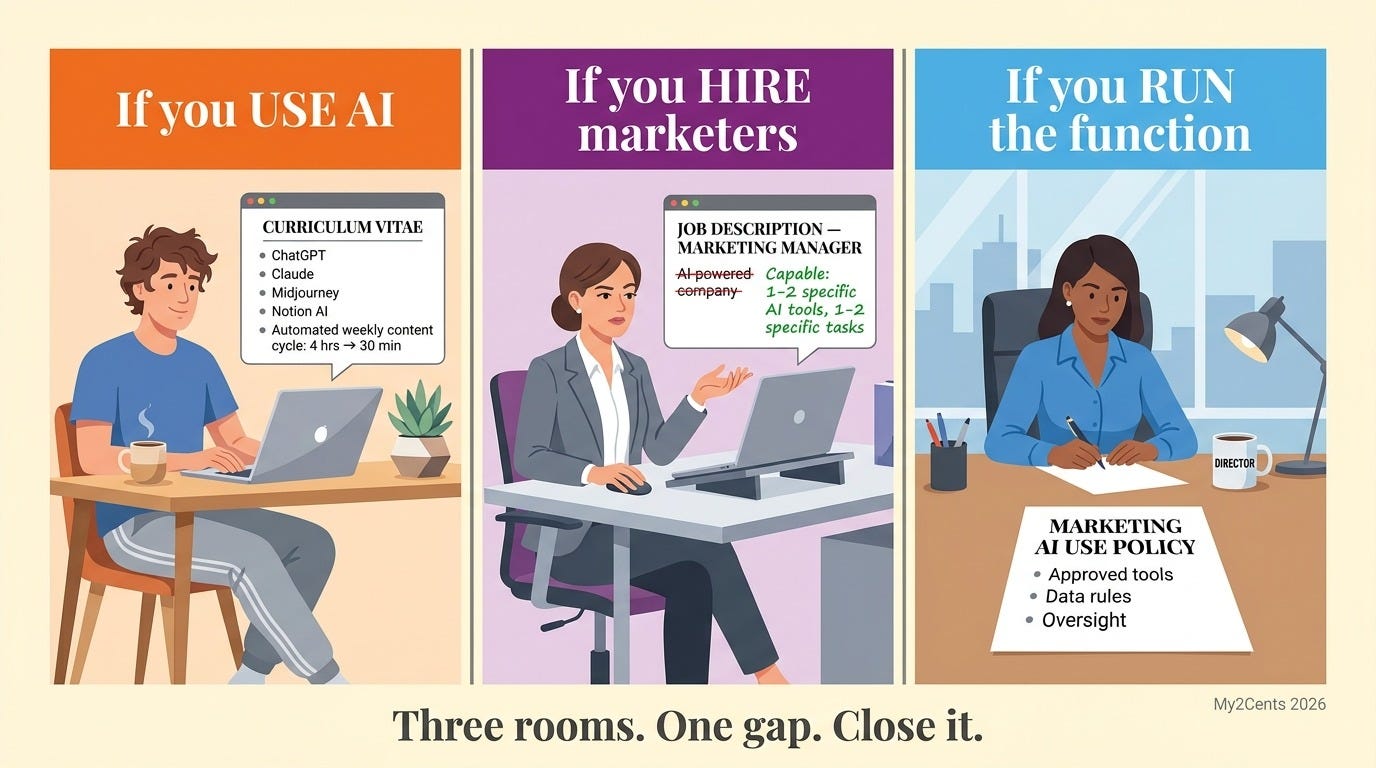
We’ll close with three things, because that’s what we do at My2Cents — make a point, analyse the data, then make recommendations on what you can do with it.
If you use AI, include it on your CV, but be specific. Not “AI-savvy” or “passionate about AI”. The exact tools, tasks and outcomes. Your dream employer probably hasn’t put AI on the JD yet, but there’s a three in four chance your hiring manager will screen you out if you can’t demonstrate how you use it. Give them the language. You’re the arbitrage.
If you hire marketers, your job ads are almost certainly sending the wrong signal. “AI-powered company” in the boilerplate with zero AI specificity in the role description is filtering out the candidates you actually want. Write the role at the Capable level at minimum — one or two concrete tools and tasks — and watch who turns up.
If you run a marketing function, your shadow-AI usage is a governance risk. It’s already happening, on someone’s personal ChatGPT account, with company/client data in the prompt. Build a usable policy — not legal’s “don’t”, but a real “do this, in these tools, with this oversight” — before the breach, not after.
What’s next
This is the first of four pieces this month. Over the next three posts, we’ll show you:
What good looks like. The Australian companies demonstrating AI fluency as a hiring requirement, and a self-assessment you can run against your own marketing function.
The missing middle. What’s happening to junior marketing roles as AI gets pulled to leadership? The squeeze is real, and the consequences compound.
The university story. Most Australian marketing courses still aren’t teaching AI. A handful are getting it right, the AI-ban paradox, and what marketing graduates are walking into.
The say/do gap won’t close on its own. It closes when individual marketers, hiring managers, curriculum leads and CMOs decide to put what they actually do with AI into what they say about it. Job ads. Syllabi. Policies. CVs.
A note on methodology
BizCover’s 91 per cent is a meaningful headline, and it deserves its caveat. It comes from a small-business sample of 92 marketing businesses in their 2025 Australian Small Business AI Report — a slice of their broader survey. The Microsoft / LinkedIn 75 per cent figure (”leaders would not hire without AI skills”) comes from the Australian leader subset of their Work Trend Index 2024. ADMA’s 77 per cent (n=1,092) and Microsoft’s 84 per cent Australian knowledge-worker figure corroborate the direction, at different samples and methodologies.
Our 3.5 per cent comes from approximately 13,000 publicly available Australian marketing job ads across leading Australian job boards between January and April 2026, filtered for ads that explicitly mention AI by name, and then scored against a four-level capability assessment. The university curriculum figures come from our March 2026 analysis of publicly available course information across 32 Australian universities and 629 marketing subjects.
For the full interactive dataset, head to jobs.my2cents.com.au.
The full series
Part one — The Say/Do Gap in AI Marketing Hiring · you are here
Ninety-one per cent of Australian marketing businesses say they use AI. Just 3.5 per cent of job ads asked for it.
Part two — Everyone’s talking about AI. Only 21 of 979 marketing roles are actually built around it. · June 2026
What the companies that mean it actually write into the job description — and the four questions that tell you whether you should.
Part three — AI is climbing the marketing career ladder from the top down · July 2026
AI capability is being hired in at the top. Of the 21 roles genuinely built around it, not one was entry-level.
Part four — AI has entered the university marketing syllabus mostly as something to police, not something to practise · September 2026
1,188 marketing subjects across 38 Australian universities. Six ask a student to prove they can direct an AI.