


The other side of the gap
In part one of this series, we compared what Australian marketers say about AI with what their job ads actually ask for. Ninety-one per cent of Australian marketing businesses say they use AI (BizCover, 2025). Three in four leaders say they wouldn’t hire someone without AI skills (Microsoft / LinkedIn, 2024). Just 3.5 per cent of approximately 13,000 job ads mention it. The gap was the story.
This time, the exceptions tell the story.
A quick word on our position. We’re not making the case that every marketing team should be transformative. Most shouldn’t, and we’ll get to why. But given how much noise there is around AI, we expected to find far more of it embedded in the actual work. What surprised us was how patchy it is: where AI shows up, it tends to live in pockets, not across whole organisations — and often not in the companies making the most noise about it.
Note: For part two, we’ve updated our data, filtered for ads that explicitly mention AI as of 18 May 2026 - 961 marketing roles or 4.4% out of 22,000. Part one used an earlier April 2026 cut of 461 AI-mentioning ads of a total of 13,000.
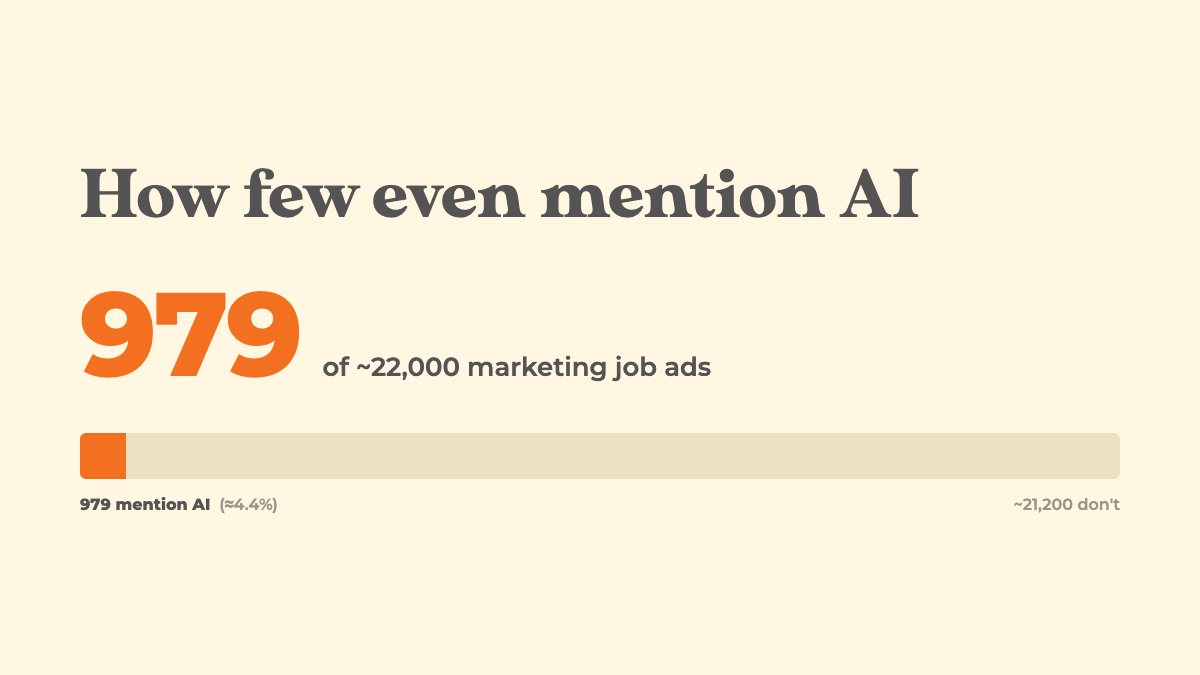
We scored 979 Australian marketing job ads — roughly 1 in 20 of the 22,000 ads we analysed, that actually mention AI — against a four-level capability assessment. We read each ad structurally: what the company says about itself, how AI sits in the marketing context, and what the role actually requires day-to-day. Then we scored each layer independently and checked whether the company’s AI rhetoric matches the role’s reality.
Twenty-one of those 979 ads are for roles operating at a transformative level — the highest capability level. Three ads were active as of 18 May 2026. And the patterns in between are where it gets interesting.
The capability assessment, unpacked
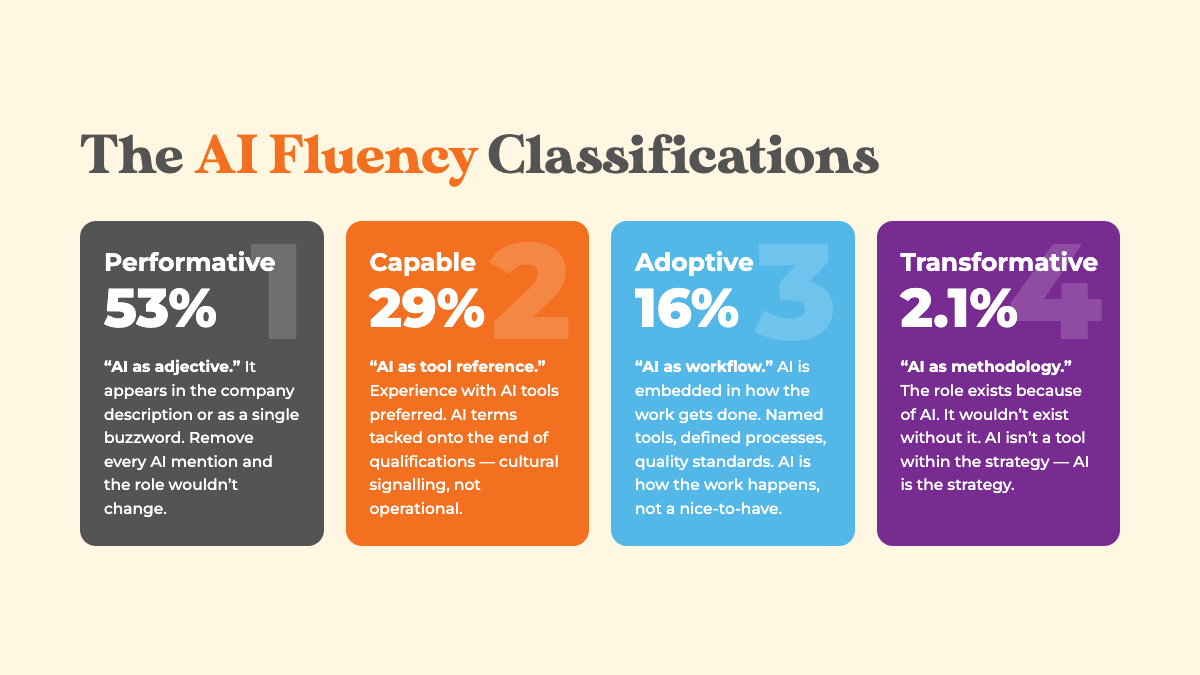
In part one, we introduced a four-level framework for reading the market. Here’s what emerges when you apply this to the 979 job ads:
Performative. The company mentions AI somewhere — usually in the “about us” or as a bullet-point aspiration — but the role itself includes no AI work. Remove every mention of AI, and the job doesn’t change. This is the biggest category.
Capable. AI shows up as a nice-to-have: “experience with ChatGPT preferred”, “familiarity with AI tools a plus.” The candidate who has it might be marginally preferred. The candidate without could still get the job.
Adoptive. AI is embedded in the role. Named tools, defined workflows, expected outputs. “You will use AI tools to [specific task]” — not “awareness of AI trends.” AI has changed the day-to-day work of marketers.
Transformative. The role exists because of AI. The marketing function has been redesigned around AI capability. AI agents, proprietary systems, prompt libraries, retrieval architectures. Humans and AI are working together by design, not by accident.
We scored each ad across three dimensions — company behaviour, marketing context and function-specific signals — then assessed coherence: does the company’s talk match its walk? That single measure turns out to be one of the most powerful signals in the dataset. More on that shortly.
The numbers
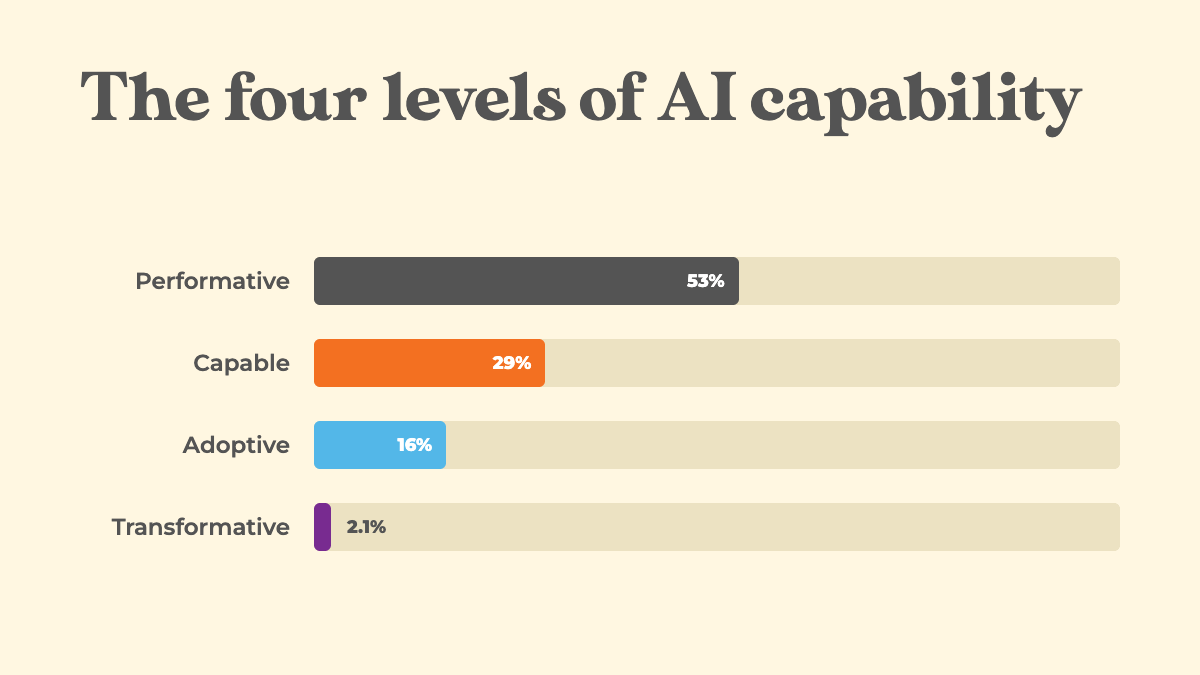
Here’s how the market distributes across those four levels.
Of the 979 marketing job ads we scored, more than four in five sit at Performative or Capable. AI is a buzzword or a nice-to-have — not the job. Roughly 16 per cent are Adoptive — companies where AI has actually changed how marketing gets done. And just 2.1 per cent — twenty-one ads — are Transformative.
What Transformative actually looks like
Twenty-one Transformative roles out of 979. Just four were active as of 18 May 2026. Here’s what the top tier looks like up close — and why these aren’t necessarily the companies you’d expect.
See the job roles for yourself. Every transformative role — with the exact job-ad language that put it at the top tier — is on the live capability explorer at jobs.my2cents.com.au.
The greenfield
This listing, posted through recruitment firm Six Degrees Executive, is for a high-growth B2B SaaS business making its first dedicated full-time marketing hire. The employer — operating at the intersection of AI, workflow automation and enterprise compliance technology, and trusted by Coca-Cola, Nike and Woolworths — didn’t retrofit AI into an existing team. They designed the function around AI from day one.
The job: AI-Led B2B Marketing Manager. The ask: “work with proprietary tooling and internal MCPs connected to platforms such as LinkedIn and Google Ads, helping drive growth while contributing to how AI agents and automations are orchestrated, governed and continuously improved.”
This isn’t “ChatGPT preferred.” This is a marketing function built around AI-enabled leverage. The employer’s marketing team is hired to use the same kind of AI orchestration the business sells to its clients. Internally consistent.
Why it’s Level 4: the role only exists because of AI — proprietary tooling and orchestrated agents are the job, not a bonus skill. • See the listing →
The survivalist: nimbl
nimbl is a boutique digital agency in Richmond, Victoria, specialising in SEO, AEO and GEO — search engine optimisation, answer engine optimisation, and generative engine optimisation — for clients navigating AI-driven search. Their job ad for an SEO Strategist says this:
“AI-native and well-versed in the latest platforms (Claude, Claude Code, Cowork, ChatGPT, Perplexity and similar). Every team member here uses AI daily, and we invest heavily in cutting-edge tooling, so we’re after someone who genuinely leans into the shift rather than works around it.”
For nimbl, Level 4 isn’t a flex. It’s a survival posture. When AI search is rewriting what their clients pay for — when ChatGPT, Gemini and Perplexity are the new front doors — the only honest response is to be better at AI than the technology that’s disrupting you. This is what high competitive necessity looks like at the functional level.
Why it’s Level 4: AI fluency is existential, not optional — the whole function is built to outrun the technology disrupting its market. • See the listing →
The one you wouldn’t expect: ansarada
ansarada doesn’t include AI in their about-us information. Their company-level AI positioning is modest — they’re a B2B SaaS for M&A deal management. But their Performance Marketing Specialist role says this:
“You use LLMs (ChatGPT, Claude, Gemini) daily — for copy, analysis, briefing, and reporting.”
And then: “We’re not looking for someone who’s planning to try AI one day. We’re hiring someone who already uses it to build smarter campaigns, find optimisation opportunities faster, and turn data into decisions without spending hours in a spreadsheet.”
The company scores modestly on AI positioning. The role scores Transformative on function-specific capability. This is the pattern we find most interesting — and the opposite of performative. A company that doesn’t talk about AI at the brand level, but whose marketing function runs on it. We’re calling this a function-led adopter.
Why it’s Level 4: quiet at the brand level, but the role demands daily LLM use across the whole workflow — the function runs on AI. • See the listing →
The paradox within one company
Microsoft is the most instructive case in our dataset. Not because they’re the best — but because they contain the full spectrum in one organisation.
Earlier this year, Microsoft’s AI Creative Director role — part of the Clipchamp and M365 Copilot team — scored Transformative across every layer. It asked for someone to “set the creative vision and quality standards for generative video systems.” That’s Level 4 work.
Right now, their Copilot Solution Play GTM Manager — a role that literally markets Copilot to enterprise customers — scores Performative on function-specific capability. The role sells AI. The role itself doesn’t use it day-to-day. Same brand. Same logo. Completely different AI demands depending on the function. This is why company-level AI positioning tells you almost nothing about what the actual jobs require. And it’s why we score at the function level, not the company level.
Don’t read the About page. Read the JD.
If the Microsoft case makes the point structurally, the pattern across the dataset makes it statistically. We identified 10 clear cases of AI washing — companies whose AI rhetoric significantly exceeds the role’s reality. A company literally named after artificial intelligence hired a traditional marketing director with zero AI requirements. An AI cybersecurity firm building autonomous penetration testing asked for a regional marketing manager with no AI in the job description. A world leader in data science and AI recruited a content marketer for thought leadership production — no AI tools, no AI workflows.
On the other side: we found 22 companies where the reverse is true — low-key at the brand level, genuinely AI-driven in the work. We’re calling them quiet adopters. And here’s the thing: this is fast becoming the norm, and that’s exactly the point. The loudest AI marketing isn’t where the real adoption lives.
Harvey Norman also deserves a mention. Three copywriter roles — two SEO, one eCommerce — all scored Adoptive on function-specific capability. Company-level AI positioning: zero. Harvey Norman doesn’t brand itself as an AI company. But their eCommerce copy team has quietly become an AI-augmented operation:
“Use AI tools and prompt crafting to improve efficiency, ideation and output quality. Human-led AI. Edit and refine AI-generated content with strong editorial judgement.”
No fanfare. No LinkedIn posts about being AI-native. Just the work.
The lesson is simple, and it cuts both ways. If you want to know which companies actually use AI in their marketing function, don’t read their About page. Read their job ads. The companies talking loudest about AI aren’t always the ones using it. The ones using it aren’t always talking.
Not everyone needs Level 4
So far this reads like a case for going Transformative. It isn’t.
Not every company needs to be transformative.
And the conversation is finally maturing past “transform or die.” The smartest marketing leaders we talk to aren’t chasing Level 4 for its own sake — they’re matching their AI ambition to their business and their function. It’s also worth repeating that a lot of what is reported right now as “AI transformation” isn’t. It’s large companies using consultants to find roles they can cut. That’s cost-cutting with an AI label on it — not a marketing function redesigned around what AI can actually do.
A recent piece by the CMO Alliance makes this point well. Their critique of the standard four-stage AI maturity model — where every company is assumed to progress linearly from stage one to stage four — can overlook organisational context. They propose four readiness vectors that determine what level of AI fluency a marketing function actually needs:
Competitive Necessity. Is AI reshaping your competitive landscape? For nimbl, the answer is existential — AI search is rewriting what their clients pay for. For a local construction firm’s marketing, it might be negligible.
Business Model Leverage. Does AI directly improve how you make money? If your marketing function is the growth engine — like a venture-scaled SaaS making its first marketing hire — AI leverage is high. If marketing is a support function in a services business, the calculation is different.
Organisational Capacity. Does your team have the infrastructure, skills and governance to adopt AI responsibly? A company with proprietary tooling already built has capacity. A company whose team hasn’t logged into ChatGPT does not.
Change Velocity. How fast is your market moving? Some industries have years. Others have months. SEO has weeks.
When all four vectors are high, Level 4 is justified — possibly necessary. When they’re mixed or low, Level 2 or Level 3 might be exactly the right answer. A retail eCommerce copy team, for instance, is well-calibrated at Adoptive: high business-model leverage (copy drives revenue), moderate competitive necessity, moderate change velocity. It doesn’t need Transformative AI; it needs to be good at what it does.
The question isn’t “are you Transformative?” It’s “should you be?”
Five questions for your next leadership meeting
We’ll close with something practical. Five questions you can take to your marketing team this week.
If you removed every AI mention from your current job ads, would the roles actually change? If not, you’re at Performative. That might be fine — but you should know it.
Do your marketing team members use AI tools daily — and does the organisation know about it? If the first answer is yes and the second is no, you have a shadow-AI problem, not an AI strategy.
Can you name the specific AI tools your team uses, what tasks they do with them, and who reviews the output? If yes, you’re at Adoptive. If the answer is “we’ve got some ChatGPT licences”, you’re at Capable.
Has AI changed what your marketing function can do — not just how quickly it does the same things? If it’s expanded the capabilities, you’re approaching Transformative. If it’s made existing tasks quicker, that’s Capable to Adoptive.
Does your competitive environment, business model, organisational capacity and change velocity justify the AI level you’re targeting? A Level 2 function with Level 2 vectors is well-calibrated. A Level 2 function with Level 4 vectors has a problem.
What’s next
This is the second of four pieces in this series. The capability assessment tells you what companies are doing. The readiness vectors tell you what they should be doing. Most Australian marketing functions are at Performative or Capable. For some, that’s a problem. For others, it’s the right answer.
Over the next two posts, we’ll look at what’s happening to junior marketing roles as AI capability concentrates at the leadership level — the squeeze is real and the consequences compound (part three). Lastly, we’ll look at the university story in detail: why 84.3 per cent of Australian marketing curricula still have zero AI content, and which two universities anticipated the shift (part four).
For the interactive dataset and capability assessment: jobs.my2cents.com.au
A note on methodology
Our capability assessment scores marketing job ads across three layers (company behaviour, marketing context, function-specific signals) and four levels (Performative → Capable → Adoptive → Transformative). We adapted Zapier’s AI fluency framework for the marketing function and applied it to 979 Australian marketing job ads from leading Australian job boards, filtered for ads that explicitly mention AI as of 18 May 2026. (Part one used an earlier April 2026 cut of 461 AI-mentioning ads.)
The readiness vectors framework is adapted from the CMO Alliance’s analysis of AI maturity models. For the full methodology and data: jobs.my2cents.com.au.
The full series
Part one — The Say/Do Gap in AI Marketing Hiring · May 2026
Ninety-one per cent of Australian marketing businesses say they use AI. Just 3.5 per cent of job ads asked for it.
Part two — Everyone’s talking about AI. Only 21 of 979 marketing roles are actually built around it. · you are here
What the companies that mean it actually write into the job description — and the four questions that tell you whether you should.
Part three — AI is climbing the marketing career ladder from the top down · July 2026
AI capability is being hired in at the top. Of the 21 roles genuinely built around it, not one was entry-level.
Part four — AI has entered the university marketing syllabus mostly as something to police, not something to practise · September 2026
1,188 marketing subjects across 38 Australian universities. Six ask a student to prove they can direct an AI.