



Part three of a four-part series on AI and Australian marketing hiring.
Everyone has a take. Almost nobody has data.
Everyone has an opinion about what AI is doing to junior jobs. The discourse says the robots are coming for the grads. The counter-take says the grads are AI-native, so they’ll be fine.
Both camps are loud. Neither is reading job ads.
So we did. Again.
In part one of this series, we measured the gap between what Australian marketers say about AI and what their job ads actually ask for. In part two, we looked at the exceptions — the small group of companies whose roles are genuinely built around AI, and what the top grade looks like up close.
This time, the question is different: who actually gets to do the AI work?
We’ve now analysed more than 22,000 Australian marketing job ads. In May, 979 of them explicitly mentioned AI. Just 21 were genuinely built around it — roles where AI isn’t decoration, but the actual shape of the job.
And of those 21 roles, exactly zero were junior.
Not a handful. Not fewer-than-we’d-hoped. Zero. March had one. April had two. The needle isn’t moving.
AI is being hired in at the top
Quick refresher on how we read the market. Every ad that explicitly mentions AI gets scored against our four-level capability assessment: Performative (AI is named but the job doesn’t use it), Capable (nice-to-have), Adoptive (embedded in the day-to-day), Transformative (the role exists because of AI). Score each ad one to four, average by group, and you get a picture of how deeply AI is built into the work.
Here’s the May picture, cut by seniority:
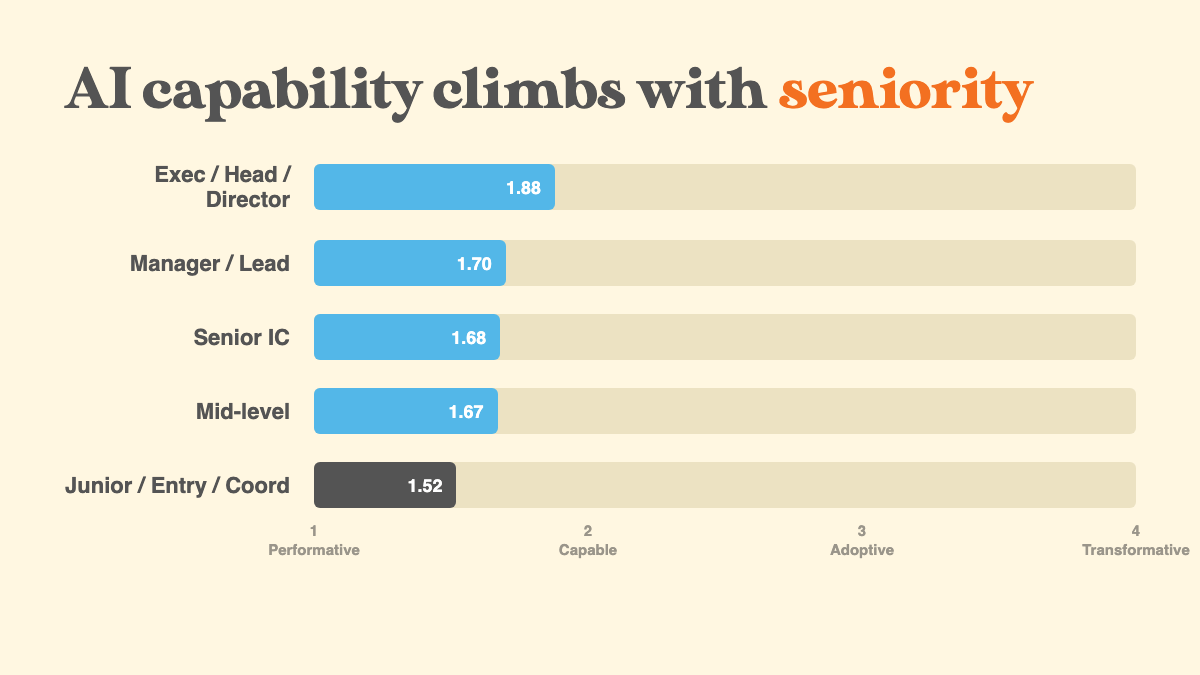
Capability climbs with seniority. And it collapses at the bottom rung — junior ads sit closest to Performative, where AI is a word in the ad rather than a feature of the job.
The trend is the sharper story. Across March, April and May, executive-level AI capability rose from 1.48 to 1.76 to 1.88. Junior stayed flat, and lowest, the whole quarter.
There’s a simpler way to see the same skew. Forget capability scoring for a second and just ask: how often does AI show up at all? In May, 21.1 per cent of executive and director-level marketing ads mentioned AI. For junior roles: 9.2 per cent. An exec ad is more than twice as likely to mention AI as a junior one. (Worth being clear: this is the broad any-mention rate, so it runs well above the 4.4 per cent of ads that explicitly mention AI — our stricter headline measure.)
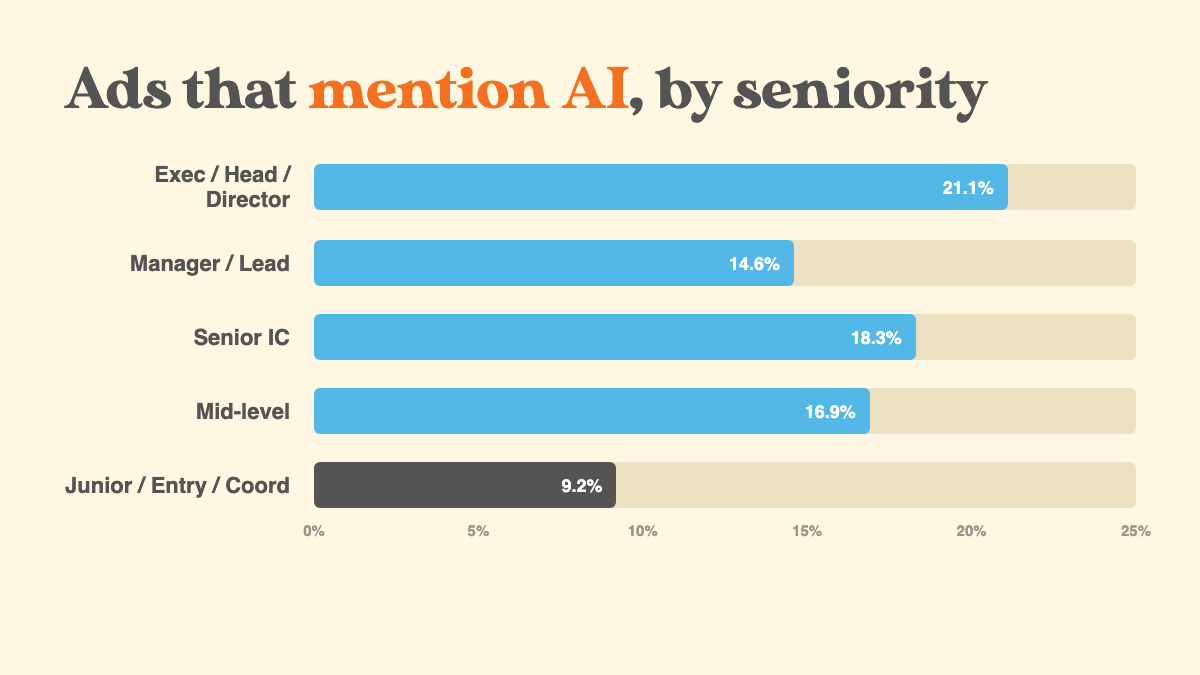
One more check, because single numbers can mislead. Look at who the AI-mentioning ads actually belong to, and the same skew appears: juniors hold a smaller share of them than they hold of the marketing job market overall, while executive and senior roles take an outsized slice.
Whichever way you cut it, the pattern holds.
It’s not just us seeing this
Our data is one lens — marketing ads, Australian, scored ad by ad. But the senior skew shows up everywhere you look.
SEEK’s own data crowned AI Engineer Australia’s most in-demand job, with ad volume up 295.6 per cent and average advertised pay around $162,000. That’s AI demand entering the market at the top and at specialist level — not at the graduate desk.
Lightcast’s global “Beyond the Buzz“ analysis found AI skills clustering in technical, data and managerial roles, diffusing only slowly to entry level.
PwC’s AI Jobs Barometer tells the same story with pay: roles demanding AI skills command a wage premium and sit at the higher-skilled end of the market. Peter Wheeler, PwC Australia’s Managing Director of Workforce and Change, put it in a sentence we haven’t been able to improve on: “AI is not devaluing expertise; it is concentrating value around trusted expertise.”
“AI is not devaluing expertise; it is concentrating value around trusted expertise.”
— Peter Wheeler, PwC Australia
Sit with that one. The value isn’t spreading down the ladder. It’s pooling at the top of it.
The one early counter-signal comes from the United States (flag: US data, not ours). NACE’s Job Outlook 2026 found AI-skill requirements climbing fastest at the entry level — off a low base of 10.5 per cent of entry-level postings, but nearly tripling since late 2025. Overseas, the AI-junior role is starting to get written. Here, we’re still waiting.
The people running marketing are hiring for AI faster than they’re embedding it in their own roles.
When we break the AI-mentioning roles down by marketing function, the deepest AI capability isn’t at the strategy and leadership layer. It’s in demand generation and performance — the measurable end of marketing — which averages 2.07 on our capability assessment. Marketing management and strategy roles sit mid-pack at 1.79.
Performance is the proving ground. It makes sense: performance marketing has tight feedback loops, measurable outputs, and tasks AI is genuinely good at today. Strategy is harder to implement. But it does raise a question for every CMO reading this… if AI capability is concentrated in the functions you manage, what’s the plan for the function that manages them?
The double-whammy at the bottom rung
So AI work is being pulled up the ladder. On its own, that’s an interesting skew. What makes it a squeeze is what’s happening at the bottom at the same time — from both sides.
Side one: the old junior jobs are thinning out.
people2people’s March 2026 employment report found 45 per cent of employers expect to hire fewer junior roles over the next three to five years — up from 14 per cent. That’s not a gentle drift. That’s a tripling of intent.
Fifth Quadrant’s SME tracker has only 9 per cent of Australian small and medium businesses actively hiring as of December 2025, down from 19 per cent in October — and SMEs are where an awful lot of marketing careers have always started.
And Stanford’s “Canaries in the Coal Mine“ study (flag: US data) found a 16 per cent relative employment decline for 22-to-25-year-olds in the occupations where AI can do the most of the work. The Stanford research matters because it suggests this isn’t an Australian quirk or a temporary hiring cycle. Independent researchers, on a different continent, using different methods, found the same pattern: the first measurable employment effects of AI are landing on the youngest workers in the most AI-affected fields. The Australian Marketing Institute has already flagged the same dynamic for marketing here.
“The first measurable employment effects of AI are landing on the youngest workers in the most AI-affected fields.”
Side two: the new junior jobs haven’t been written yet.
If AI were simply reshaping entry-level work, you’d expect a new kind of junior ad to appear — the AI-junior role. The coordinator who runs the prompt library. The grad who owns the workflow automations. The entry-level marketer hired to be the team’s AI hands.
That ad barely exists. Junior ads are the least likely to mention AI at all, remember — 9.2 per cent.
Why? Our best answer after reading thousands of these ads: managers can’t define the role. Most marketing managers aren’t yet AI-literate enough to describe what an AI-native junior would actually do all day. And you can’t hire for what you can’t describe.
So traditional junior tasks are steadily being automated, while the new entry-level roles that should be designed around AI haven’t been created. The result is a gap between the jobs that are fading and the jobs that have yet to emerge — and it’s juniors standing in that gap.
The irony is brutal. Today’s graduates arrive with more AI experience than any cohort before them. And the market is hiring AI capability almost exclusively into senior and specialist roles — leaving the most AI-ready generation with the fewest professional opportunities to use it.
“The most AI-ready generation in history — with the fewest professional opportunities to use it.”
A junior with strong AI skills reporting to a manager who can’t evaluate them is like a brain surgeon being managed by a first-aider. The capability is there. The system doesn’t know what to do with it.
Hire, fire… re-hire?
There’s a plot twist forming in the data, and it’s one every finance director should read before signing off the next restructure.

people2people calls it the “AI-driven redundancy cycle“: up to half of the employers who cut customer service, admin and entry-level marketing headcount on the promise of AI may be forced to re-hire into similar roles by 2027. Cut on the promise, re-hire on the reality.
AHRI’s December 2025 Work Outlook shows the churn in one snapshot: 30 per cent of organisations expect redundancies — and 91 per cent of those same organisations plan to recruit in the same quarter. That’s not a shrinking workforce. That’s a workforce being shuffled, at considerable expense, by organisations that aren’t sure what they’re doing yet.
Agencies are bearing the brunt locally. The Advertising Council of Australia’s 2025 salary survey put the industry redundancy rate at 11 per cent, against a historical norm of 5 to 7 per cent. Add the Omnicom–IPG merger (around 4,000 roles globally) and local cuts at Nine and Seven West, and the private-sector marketing job market is doing plenty of firing while it talks about transforming.
And if the squeeze persists, the bill arrives later. Entry-level roles are where organisations have always grown their future specialists, managers and leaders. Narrow that pathway and you might solve this year’s headcount challenge — while quietly running a single-child policy on your own talent pipeline. Plenty of seniors today. Nobody is coming through tomorrow. Where exactly is the next generation of experienced marketing talent supposed to come from?
We’ve seen this movie before
If this all feels familiar, it should. It’s the digital-transformation wave with the labels swapped: loud claims, hiring that doesn’t match the claims, and a coming boom in “AI transformation” consultancies with the same mixed results as the last lot.
Even the optimistic data has a say/do gap buried in it. AHRI reports that 41 per cent of organisations claim AI is increasing entry-level roles. Encouraging — until you split it: 58 per cent of public-sector organisations say so, versus 37 per cent private. The optimism is concentrated exactly where commercial pressure isn’t. In private-sector marketing, the numbers point the other way.
Say/do gap, all the way down.
What the data doesn’t say
The data does not say AI is killing junior marketing jobs. Total marketing ad volume hasn’t collapsed. The churn data says organisations are re-hiring even as they cut. What the data describes is a bottom rung being rebuilt in place — narrower, more hybrid, more demanding, and not yet redesigned around the technology reshaping it.
The squeeze is real at the point of entry. The apocalypse framing is the same over-claim we caught in part one — just pointed at grads this time.
And what happens to graduates after that harder entry point — how the university pipeline is (and isn’t) preparing them, and what the longer-run outcomes actually look like — is a story big enough that we’re giving it a piece of its own. That’s part four.
What to actually do about it
If you run a marketing team, here are four recommended moves — none of them radical, but all of them rare.
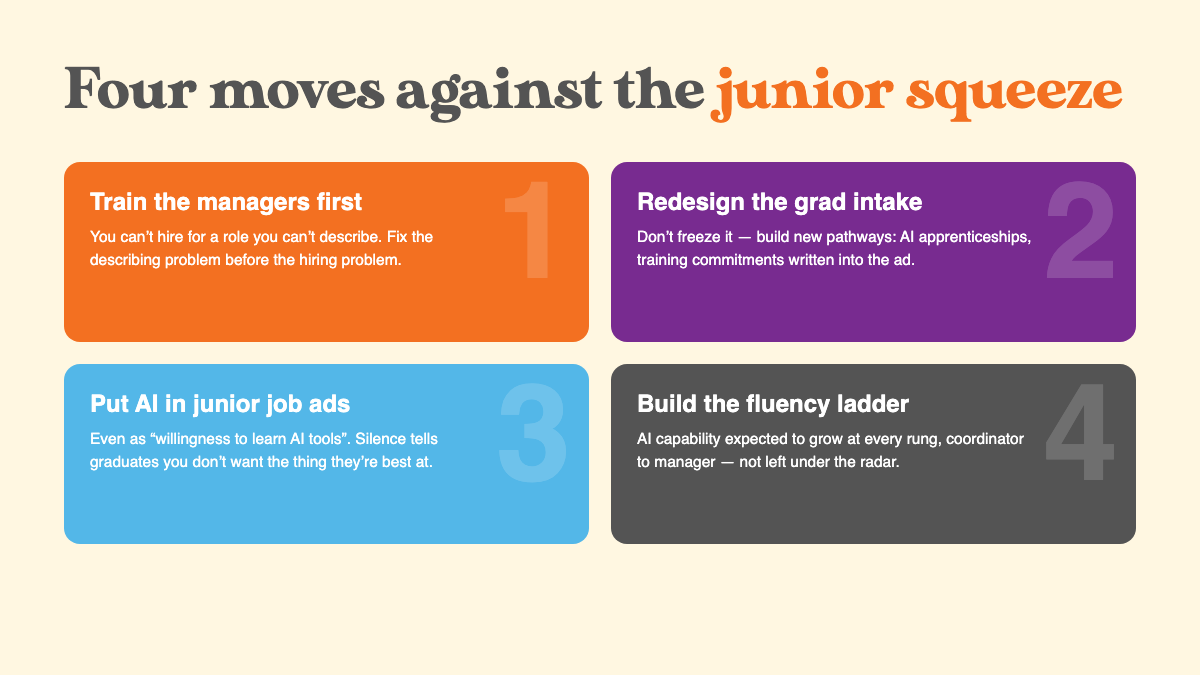
Train the managers first. The junior AI role doesn’t exist because managers can’t describe it. Fix the describing problem before the hiring problem. You can’t write the JD for a job you don’t understand.
Don’t freeze the grad intake — redesign it. The cheapest response to uncertainty is to stop hiring juniors. It’s also the one that costs you a talent pipeline. Build different pathways instead: AI apprenticeships, explicit training commitments written into the ad.
Put AI development in junior JDs. Even as “willingness to learn AI tools” — Jobs & Skills Australia‘s digital-fluency framing is a ready-made starting point. Right now, 9 in 10 junior marketing ads are silent on AI. Silence tells the most AI-ready generation in history that you don’t want the thing they’re best at.
Build the fluency ladder. Coordinator to manager, with AI capability expected to grow at every step. The alternative is what part one found: juniors using AI anyway, under the radar, with no guardrails and no credit.
What’s next
This is the third of four pieces. Part one measured the say/do gap. Part two showed what good looks like. This one showed who’s being left out of it. Part four goes to where the pipeline starts: why 84.3 per cent of Australian university marketing curricula still contain zero AI content — and why a couple of universities saw this coming years early.
If you’ve hired a junior marketer this year — or tried to be one — we’d genuinely love to hear how it went. Did the ad mention AI? Did the interview? Share your 2c.
For the interactive dataset: jobs.my2cents.com.au
A note on methodology
Our capability assessment scores marketing job ads that explicitly mention AI across four levels (Performative → Capable → Adoptive → Transformative), adapted from Zapier’s AI Fluency framework for the marketing function. Seniority is classified from job titles. Capability and distribution figures come from our frozen monthly cohorts (March–May 2026) of ads from leading Australian job boards; the any-mention rates by seniority are a broader measure than the built-around-AI rate and are labelled as such above. For the full methodology and data: jobs.my2cents.com.au.
The full series
Part one — The Say/Do Gap in AI Marketing Hiring · May 2026
Ninety-one per cent of Australian marketing businesses say they use AI. Just 3.5 per cent of job ads asked for it.
Part two — Everyone’s talking about AI. Only 21 of 979 marketing roles are actually built around it. · June 2026
What the companies that mean it actually write into the job description — and the four questions that tell you whether you should.
Part three — AI is climbing the marketing career ladder from the top down · you are here
AI capability is being hired in at the top. Of the 21 roles genuinely built around it, not one was entry-level.
Part four — AI has entered the university marketing syllabus mostly as something to police, not something to practise · September 2026
1,188 marketing subjects across 38 Australian universities. Six ask a student to prove they can direct an AI.