



Part four of a four-part series on AI and Australian marketing hiring.
Everyone is worried about the graduates. Nobody has read the syllabus.
The most AI-native people you will ever hire are graduating this year. From courses where AI mostly appears as a rule about cheating.
In part one we measured the gap between what Australian marketers say about AI and what their job ads ask for. In part two we found the companies whose roles are genuinely built around it. In part three, across more than 22,000 Australian marketing job ads, we found AI capability being hired in at the top of the ladder and almost never at the bottom.
Which leaves the obvious question. If employers want AI-fluent marketers and aren’t writing entry-level roles for them, what is the pipeline producing?
So we read it. Every marketing subject running at an Australian university in 2026 — course description, learning outcomes, assessment tasks, and the AI policy where one is published. 1,188 subjects. 38 universities.
Six of them ask a student to produce something that proves they directed an AI and can show their working.
Six.
The six that make you prove it
Here are six examples we found — subjects where the published assessment requires the student to hand over evidence of how they worked with the machine.
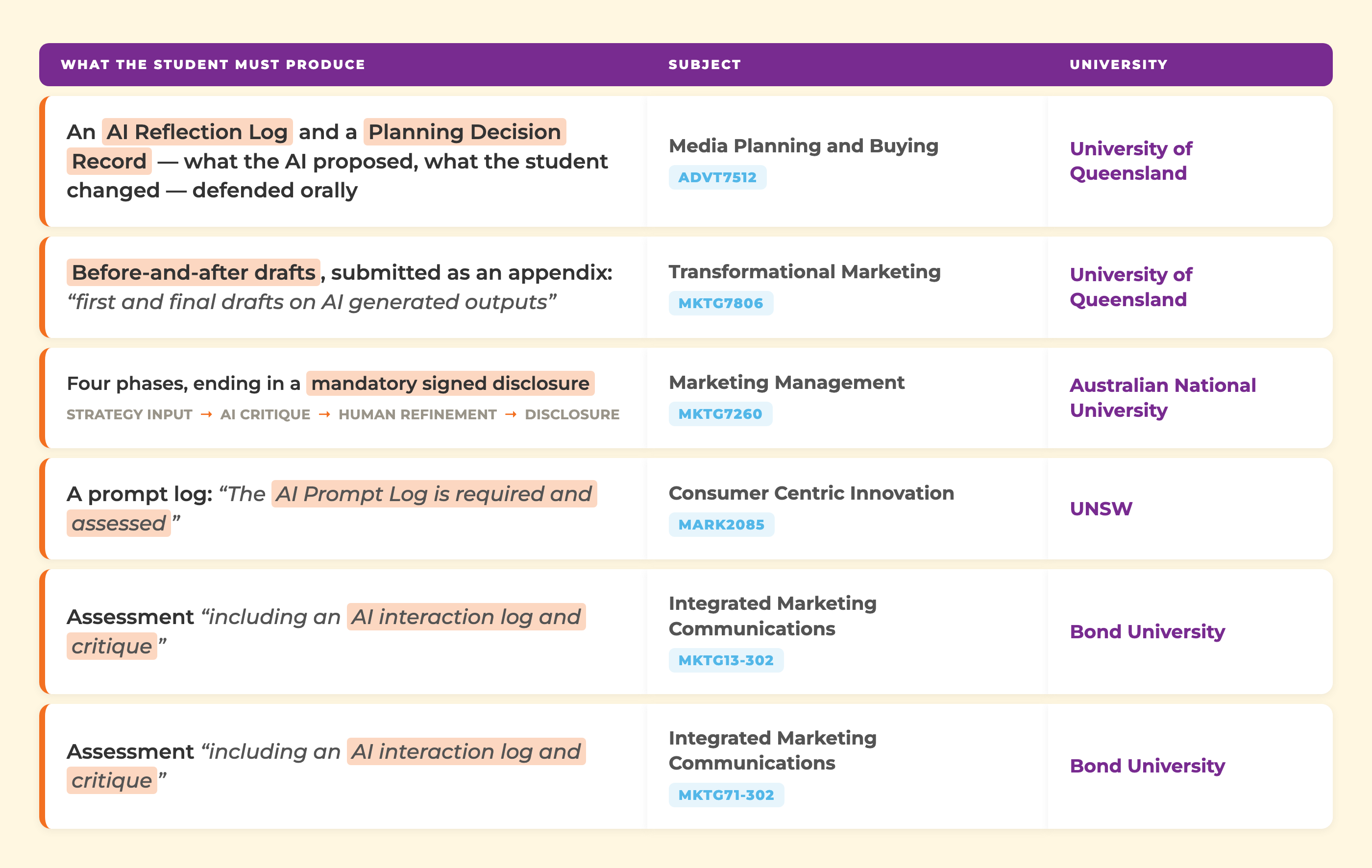
Every one of those is a portfolio piece, and that matters more than the grade attached to it. A grade proves nothing an employer can interrogate. A decision record showing where a graduate overruled the machine is precisely what the transformative job ads in part two were written to find.
The clearest statement of the idea in the entire dataset comes from a university, not from us.
“The skill being assessed is not whether you used AI but whether you directed it well: where you took its output, where you corrected it, and where your judgement went.”
— University of Queensland, ADVT7512 Media Planning and Buying
The same task asks students to explain “not just what you decided but why, what you rejected, and where you overruled or corrected the AI.”
Read that as a hiring manager and it stops sounding like a syllabus. It sounds like an interview.
The courses with AI in the title are not the courses that make you prove it
Sixteen marketing subjects in Australia have AI in the name. AI for Market Intelligence. Artificial Intelligence for Modern Marketing. AI for Marketing Insights. AI Ad Lab. Marketing Analytics and AI.
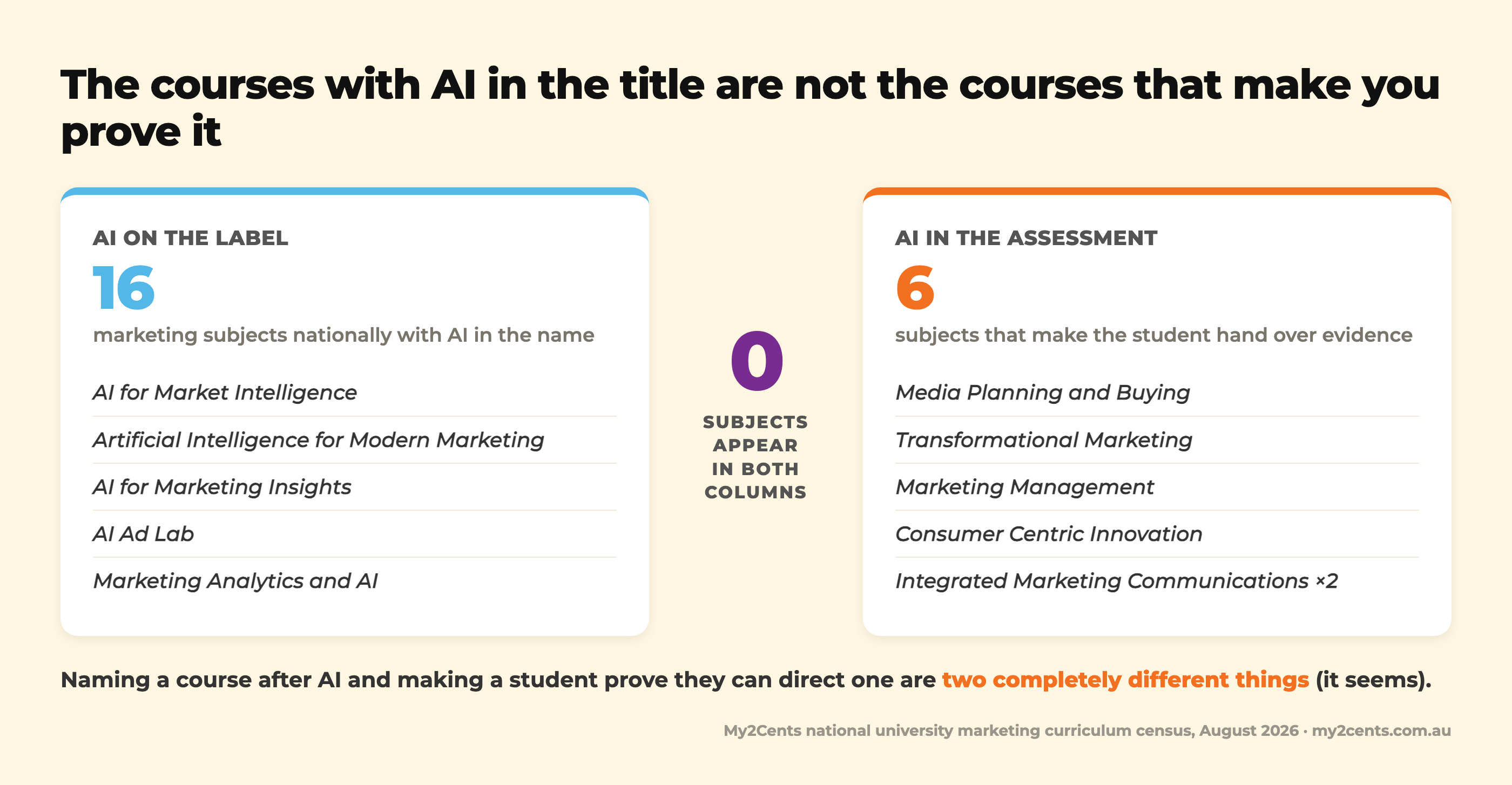
Not one of them asks a student to hand over evidence of how they directed an AI.
The ones that do are called Media Planning and Buying, Transformational Marketing, Marketing Management, Consumer Centric Innovation, and Integrated Marketing Communications. Ordinary names. The AI is in the assessment, not on the label.
The cheap read is that the AI-titled courses are marketing rather than teaching, and our own data kills that. Nearly all of them genuinely teach AI and certify it in their learning outcomes. They are real courses, built by people who meant it.
Naming a course after AI and making a student prove they can direct one are two completely different things (it seems). The sector is doing a great deal more of the first.
We have watched this exact film before
Renaming ahead of rewriting is not an AI phenomenon. It’s how the education sector has answered every technology shift so far, and we have watched it happen at close range.
Eight years ago we were consulting to the higher education sector, reviewing the digital component of Australian marketing qualifications, and we ran our own analysis of what employers were actually asking for. The finding was stark: in 2018, 75 per cent of Australian marketing job advertisements contained the word “digital”. The qualifications did not.
What happened next is what always happens next. If employers are asking for it, the recommendation went, it may be valuable to have the term “digital” reflected in the name of the qualification.
Rename the course.
Eight years on, the pattern is the same one this research has just measured. “Digital” was appearing in qualification names faster than it was reaching the curriculum, and AI is now producing much the same response. Universities can be slow to change and remarkably quick to react at the same time.
AI arrived as a rule before it arrived as a skill
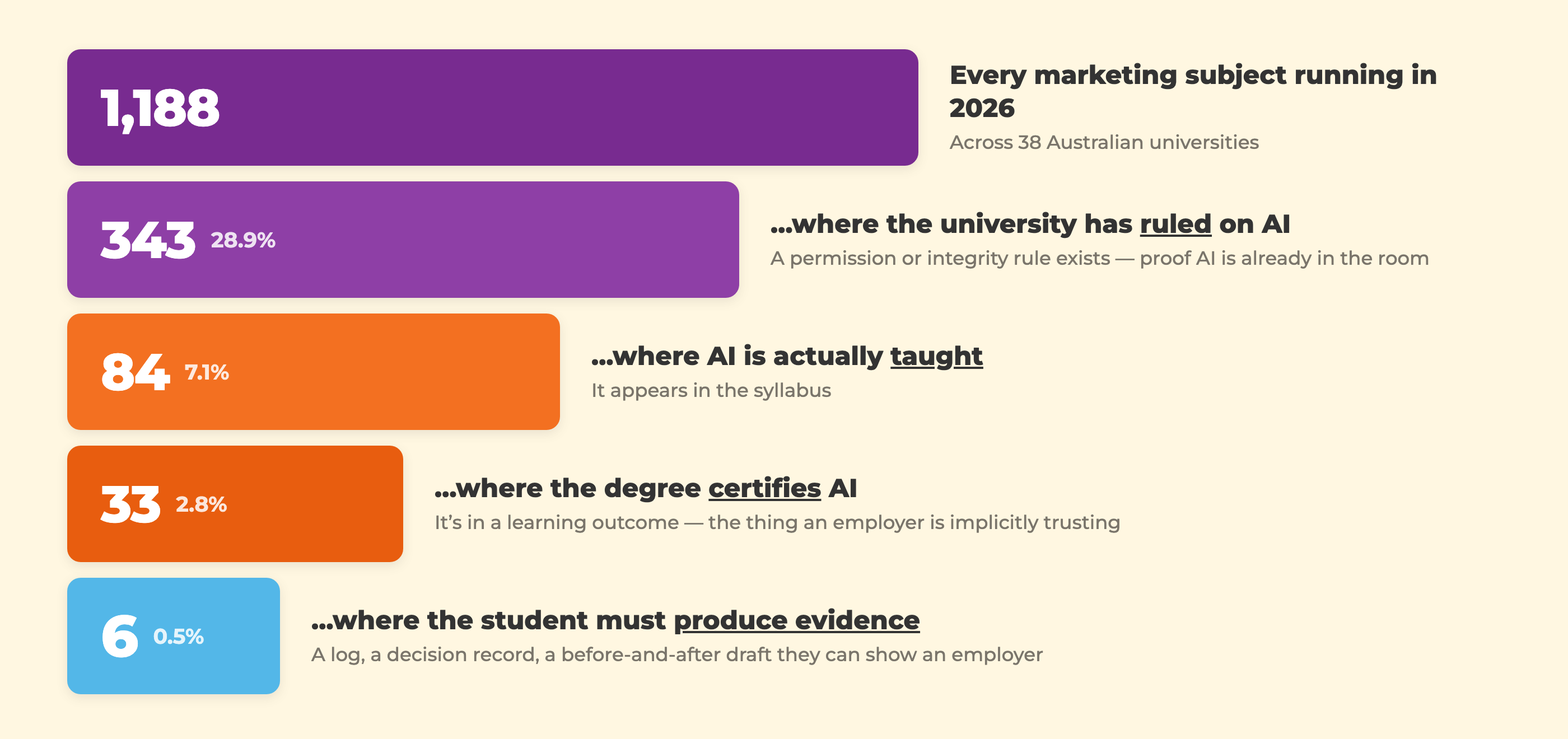
The shape of that is the finding. A rule about AI is now routine, teaching it is not, and asking a student to prove it is vanishingly rare. (These figures replace the ones we published in March. Detail in the methodology note.)
That top rung deserves a name. Call it the permission layer — the per-subject rules setting out when a student may use AI, for which task, and how they must declare it. One university tags all 78 of its assessment tasks with an AI tier. Another runs a three-level framework across every subject in the business school. Serious institutional work. And 284 of those 343 subjects have no AI at all in what they teach or assess.
There’s a straightforward reason for that, and it’s why this isn’t a story about universities being slow. In June 2024 the regulator sent every registered provider in the country a request for information, asking each one for a plan “to address the risk gen AI poses to award integrity”. Every provider responded. Read what was asked for: risk, and award integrity. Nobody was asked to teach anyone anything.
Universities built the permission system first because the permission system is what they were required to build.
The other half of it is pace. An assessment policy takes a meeting; a learning outcome takes an accreditation cycle. The course-review record from our 2018 review puts that cycle at seven years, blaming the qualification’s declining popularity partly on a “lack of innovative content since last course review 7 years ago”. That is a university documenting its own speed limit.
And nobody writes a task-by-task rule about AI unless students are already using AI in those tasks. A survey of 8,458 students across four Australian universities found 83.2 per cent using generative AI. The permission layer isn’t hypothetical policy. It’s a response to what is already happening in the room.
Universities have engaged with AI in the classroom. It just hasn’t reached the record.
It’s not just us seeing this
If AI were so embedded in marketing degrees that it didn’t need writing down, the paid market wouldn’t exist. It does, and it’s priced.
Our scan of 91 Australian non-university marketing offerings found at least 21 paid AI-marketing products on sale, from $99 to $5,800. Prices are moving up, not down. And there’s now a nationally accredited qualification for it — the Diploma of Social Media Marketing with Artificial Intelligence, accredited in March 2026, with eleven registered training organisations on scope since.
That answers the main defence of the university position — that AI is now so embedded in the teaching it doesn’t need listing separately. The rapid growth of targeted short courses, and the prices people are willing to pay for them, points to a clear market demand that degree programs are not meeting. Capability that is genuinely embedded everywhere does not command $5,800.
What the paid market sells that a degree mostly doesn’t is proof. A five-minute video plus documentation. A complete AI-enabled campaign. A working AI agent and the business case behind it.
The sharpest example is a two-week TAFE Queensland workshop that costs $195 and sends a student away with portfolio evidence that 1,182 of the 1,188 university subjects don’t ask for. It carries a Statement of Participation, worth nothing formally.
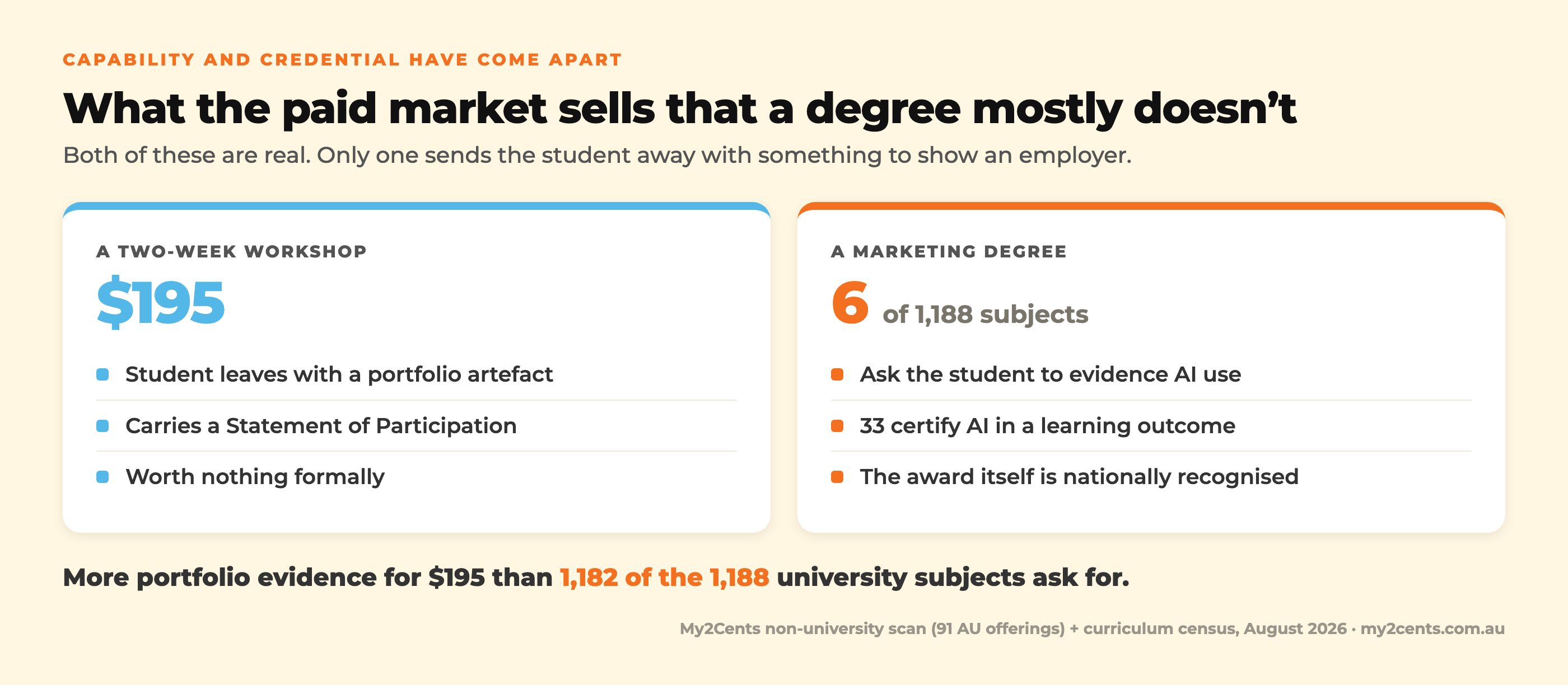
Capability and credential have come apart.
Small irony in that. On that same 2018 committee, micro-credentials were dismissed out of hand — one faction argued that collecting them would be “like collecting Pokémon”. They were half right. Micro-credentials didn’t replace the degree. They just quietly became the place you go to get the evidence.
Meanwhile the vocational sector keeps building. An $11 million Commonwealth and NSW investment has turned a Sydney TAFE campus into a national digital centre of excellence — Microsoft co-designed microcredentials, 50,000 Australians a year, and an introduction to agentic AI as its first course out the door. Its verticals are cyber, cloud, data, software development and construction.
Marketing isn’t one of them.
Where it is being done properly
The story here is concentration, not absence — and the concentration is genuinely good.
UNSW has built four marketing courses entirely around AI, all four certifying it in their learning outcomes. The University of New England runs the deepest single unit we found anywhere, declaring that “the extensive use of generative AI is a key feature”. Central Queensland has the highest rate of any university measured. UQ assesses AI harder than anyone in the country. Wollongong, UWA, La Trobe, Edith Cowan, RMIT and Monash all carry dedicated AI marketing subjects.
And the pipeline is filling. Swinburne’s AI Ad Lab is the most AI-dense marketing unit in the country, running from prompt engineering to agentic AI to disclosure obligations. It first teaches in Semester 1, 2027, and Charles Sturt, Deakin and QUT all have AI marketing arriving the same year.
This is a photograph of 2026, and the shutter caught a sector mid-stride.
Bond does it without ever naming a course after AI. It has no AI-titled marketing subject at all — its AI sits inside conventionally named ones, and two of the six subjects in the country that make a student prove it are Bond’s. On the hardest measure in this study, Bond is one of only four universities in the country.
Dr Vishal Mehrotra, Program Director – Business & Management at Bond Business School, describes the choice behind that:
“At Bond Business School, we made a deliberate decision to treat AI literacy as a core marketing competency — not as an elective or isolated module, but as something woven through how students research, plan, create, execute, and evaluate.
That means using real tools in messy real marketing contexts, not simply discussing AI at a conceptual distance… The gap this research identifies is real. Bond’s role is to ensure our graduates are not on the wrong side of it.”
Weaving AI through an existing subject and assessing the process is more work than naming a new elective after it, and it shows up in fewer of our columns precisely because it’s woven.
What the data doesn’t say
We are not saying any university fails to teach AI. We can’t see inside a classroom, and neither can anyone else reading from outside. What we can establish is what a prospective student — or an employer reading a transcript — is able to find out. Where a subject shows nothing, the honest description is no published evidence of AI capability, not an absence of AI.
The gap between those two statements is where this whole piece lives. Take one course in the census called Digital Marketing and AI. None of the four learning outcomes it certifies mentions AI, and neither does the description prospective students read. Does it teach AI? Almost certainly — somebody renamed it for a reason. Can we prove it? No. Neither can the student.
Publication depth varies enormously, so several zeros in our data are unmeasurable rather than measured. One university publishes only a syllabus paragraph. One publishes no topic list for any of its forty marketing courses. National rates are therefore computed only over the universities that publish the section being counted.
Even excellence can be invisible. One handbook renders an AI course title with a lower-case L in place of the capital I — search its own system for “AI” and the course doesn’t exist.
If you have to work that hard to find it, that tells you something on its own. And if a university reads this and says it’s nonsense — fair enough. Then why can’t we find it?
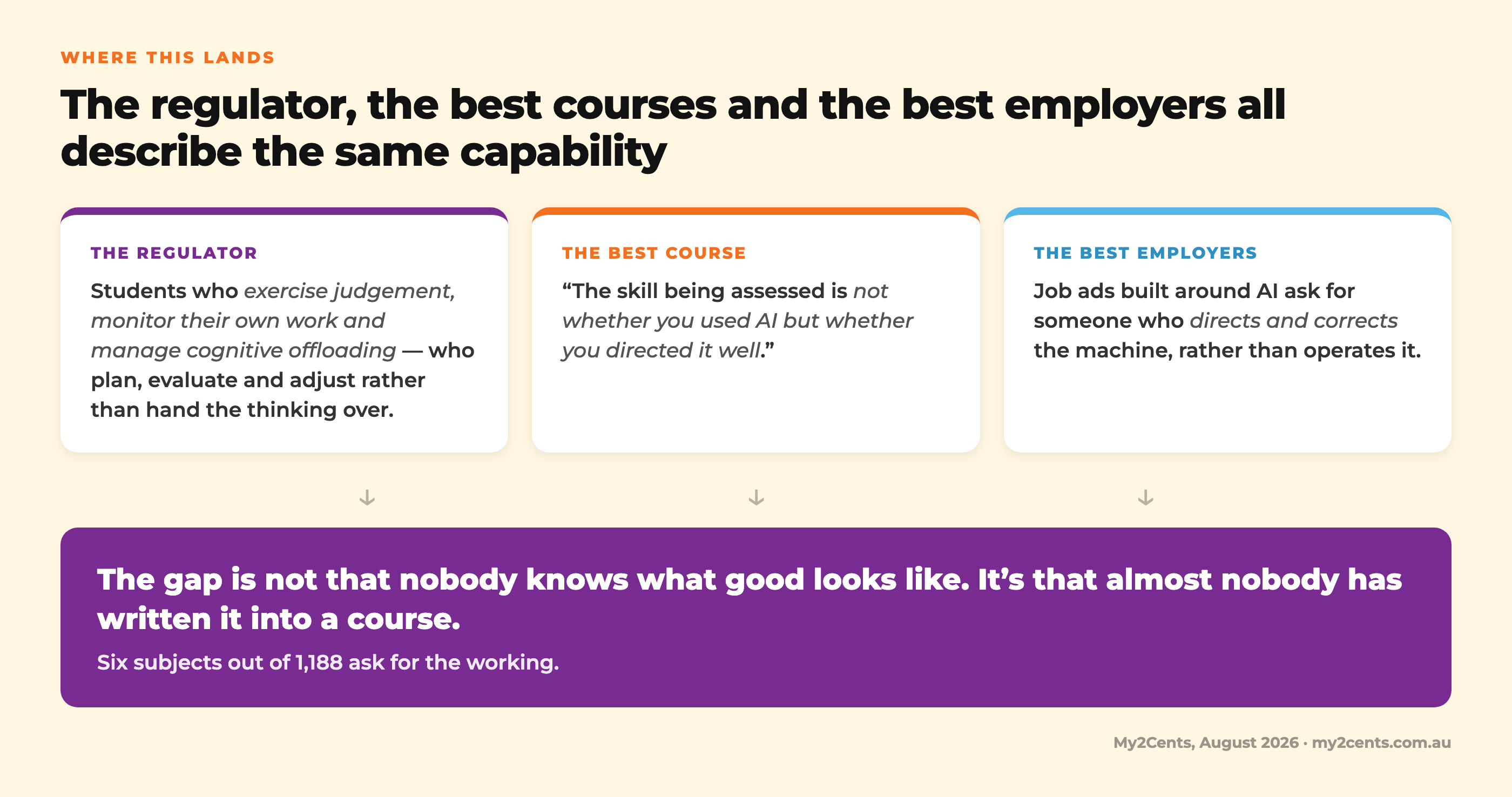
The regulator, the best courses and the best employers all want the same thing
Three parties, no contact between them, same answer.
The regulator’s current position, published in June 2026, argues for students who exercise judgement, monitor their own work and manage cognitive offloading — who plan, evaluate and adjust rather than hand the thinking over.
The best course in our census assesses “not whether you used AI but whether you directed it well”.
And the transformative job ads in part two ask for exactly that: someone who directs and corrects the machine, rather than operates it.
Banning AI is like telling students they’re not allowed to use a calculator. The answer is the one the exam hall worked out decades ago: bring the calculator in, we expect you to use it, just show us your working.
Six subjects out of 1,188 ask for the working.
What to actually do about it
If you’re hiring, stop reading the degree and start asking for the artefact. The graduate who can hand you a decision record — here’s what the AI proposed, here’s where I overruled it, here’s why — is demonstrating exactly what the best job ads in this series were written to find. Most graduates won’t have one. The ones who do have just told you everything.
If you’re studying, or choosing a course, read the learning outcomes rather than the course name. Look for a verb that makes something — develop, design, implement — not consider, explore, understand. Ask what you’ll walk out with that you can show someone. If you can’t tell from the published record, that’s a fair question for the convenor before you enrol.
If you’re a marketer already, the formal system isn’t going to fill this in for you yet. ADMA’s most recent numbers have 77 per cent of Australian marketers using AI weekly and 13 per cent with any formal training. Most of a profession, self-taught on the tool it uses every week.
And if you sit on a course advisory board, read what the market is asking for, then check what your qualification certifies. It’s a two-hour job. Somebody did it in 2018 with the word “digital”, and the answer that came back was to rename the course.
What’s next
That’s the series. Part one measured the say/do gap. Part two showed what good looks like when a company means it. Part three showed who’s being left out of it. This one went to where the pipeline starts.
The tidy conclusion would be that universities are behind the market. They aren’t, particularly. Of the more than 22,000 job ads in this series, the roles we scored in detail put roughly two per cent at the top capability level. Universities certify AI in roughly three per cent of marketing subjects. Different instruments, so not a league table — but nobody is lapping anybody.
If you’ve hired a marketing graduate this year, or you’re teaching one, we’d like to know what the published record looked like from your side. Did the syllabus say anything? Did the graduate? Share your 2c.
For the interactive dataset: jobs.my2cents.com.au
A note on methodology
Between 7 and 10 August 2026 we read the published record for every marketing subject running at an Australian university in 2026: 1,188 subjects across 38 universities, with 242 verbatim evidence quotes captured. For each subject we scored four sections independently — course description and taught content, learning outcomes, assessment tasks, and AI permission or integrity text — rather than scoring the page as a whole. Beyond the funnel above, 103 subjects (8.7 per cent) carry an AI signal somewhere in the record, and 33 (2.8 per cent) put AI in an assessment task.
National rates are computed only over universities that publish the section being counted. Where a university publishes no learning outcomes or no assessment descriptions, its subjects are excluded from those rates rather than counted as zeros. Across the 24 universities that publish both teaching and assessment, 11.4 per cent of marketing subjects carry AI in one or the other.
The non-university comparison covers 91 Australian marketing offerings scanned on 10 August 2026, 45 scored in detail. Denominators are not like-for-like and those figures are directional only. No Australian provider publishes enrolment volumes, so we make no claim about how many people are buying these courses — only about what is on sale, and at what price.
Job-ad figures come from the more than 22,000 Australian marketing job ads analysed across this series, drawn from leading Australian job boards and scored against our four-level capability assessment. Student usage figures come from Chung, Henderson et al., The use and usefulness of GenAI in higher education: Student experience and perspectives, Computers and Education Open, published online June 2026 — a survey of students at four Australian universities, not a national sample.
For the full methodology and data: jobs.my2cents.com.au
—
The full series
Part one — The Say/Do Gap in AI Marketing Hiring · May 2026
Ninety-one per cent of Australian marketing businesses say they use AI. Just 3.5 per cent of job ads asked for it.
Part two — Everyone’s talking about AI. Only 21 of 979 marketing roles are actually built around it. · June 2026
What the companies that mean it actually write into the job description — and the four questions that tell you whether you should.
Part three — AI is climbing the marketing career ladder from the top down · July 2026
AI capability is being hired in at the top. Of the 21 roles genuinely built around it, not one was entry-level.
Part four — AI has entered the university marketing syllabus mostly as something to police, not something to practise · you are here
1,188 marketing subjects across 38 Australian universities. Six ask a student to prove they can direct an AI.